What it means
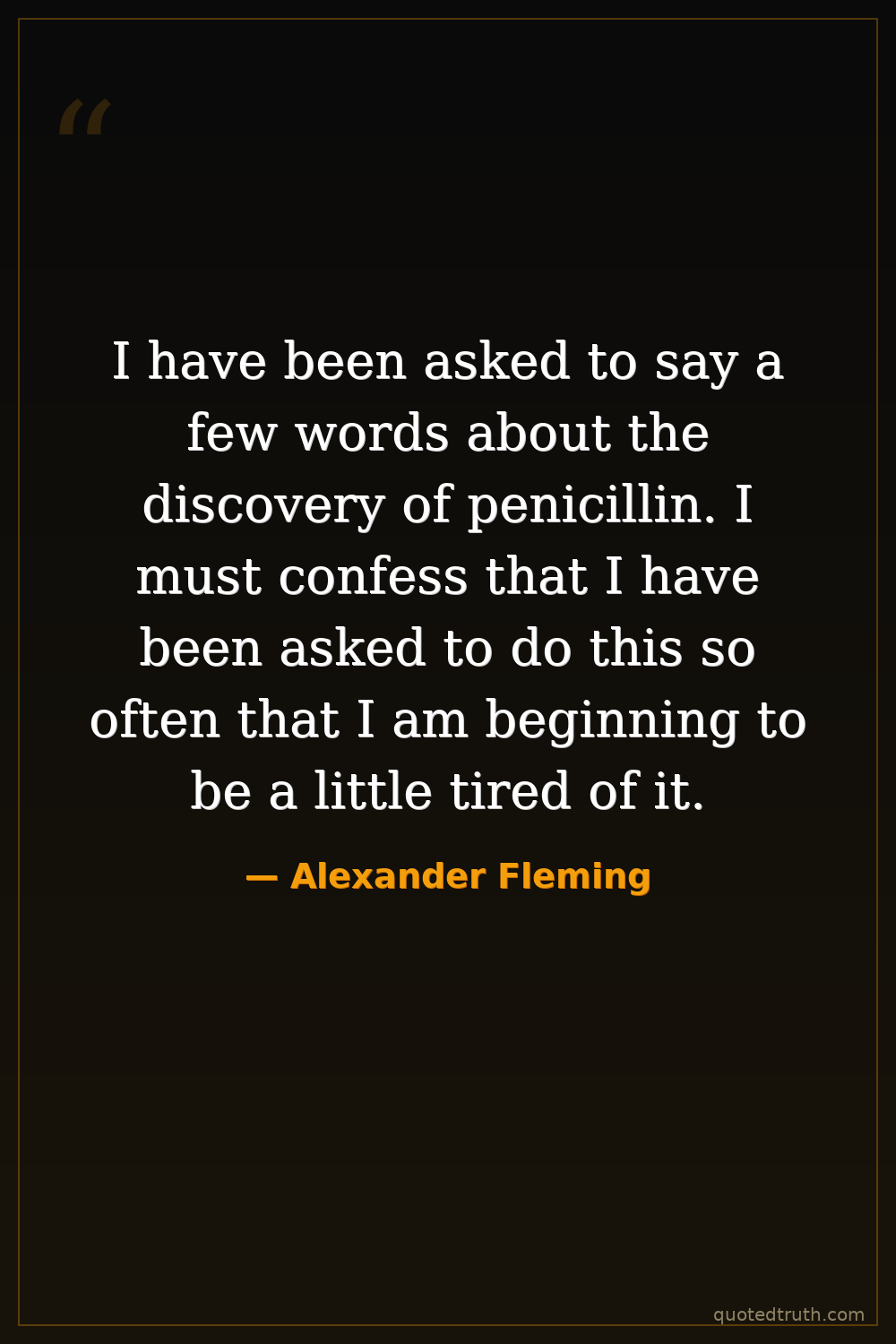
Fleming admits with dry humor that fame for a single achievement becomes its own burden. He's not boasting — he's confessing genuine weariness at being asked to repeat the same story endlessly. The quote captures the irony of success: the discovery that defined his legacy also tethered him to one moment forever. It speaks to how even a transformative contribution can feel repetitive when it becomes your only public identity.
Relevance to Alexander Fleming
Fleming was a reserved Scottish bacteriologist who stumbled on penicillin in 1928 by noticing mold killing bacteria in a contaminated dish — a famously accidental discovery. After winning the 1945 Nobel Prize, he became one of the most publicly celebrated scientists alive, perpetually in demand for speeches and interviews. Fundamentally a lab scientist rather than a public figure, Fleming found the celebrity circuit exhausting, and his dry Scottish wit perfectly expressed that discomfort.
The era
Penicillin's mass production during World War II saved hundreds of thousands of lives from infected wounds, making Fleming a global hero by the mid-1940s. The postwar world stood in awe of science — atomic energy, vaccines, and antibiotics seemed to promise unlimited human progress. Fleming received honorary degrees from dozens of universities and was mobbed wherever he traveled. In an era before fragmented media, a handful of scientists became genuine worldwide icons.
AI-generated insights based on extensive research and information for context. Factual errors? Email [email protected].