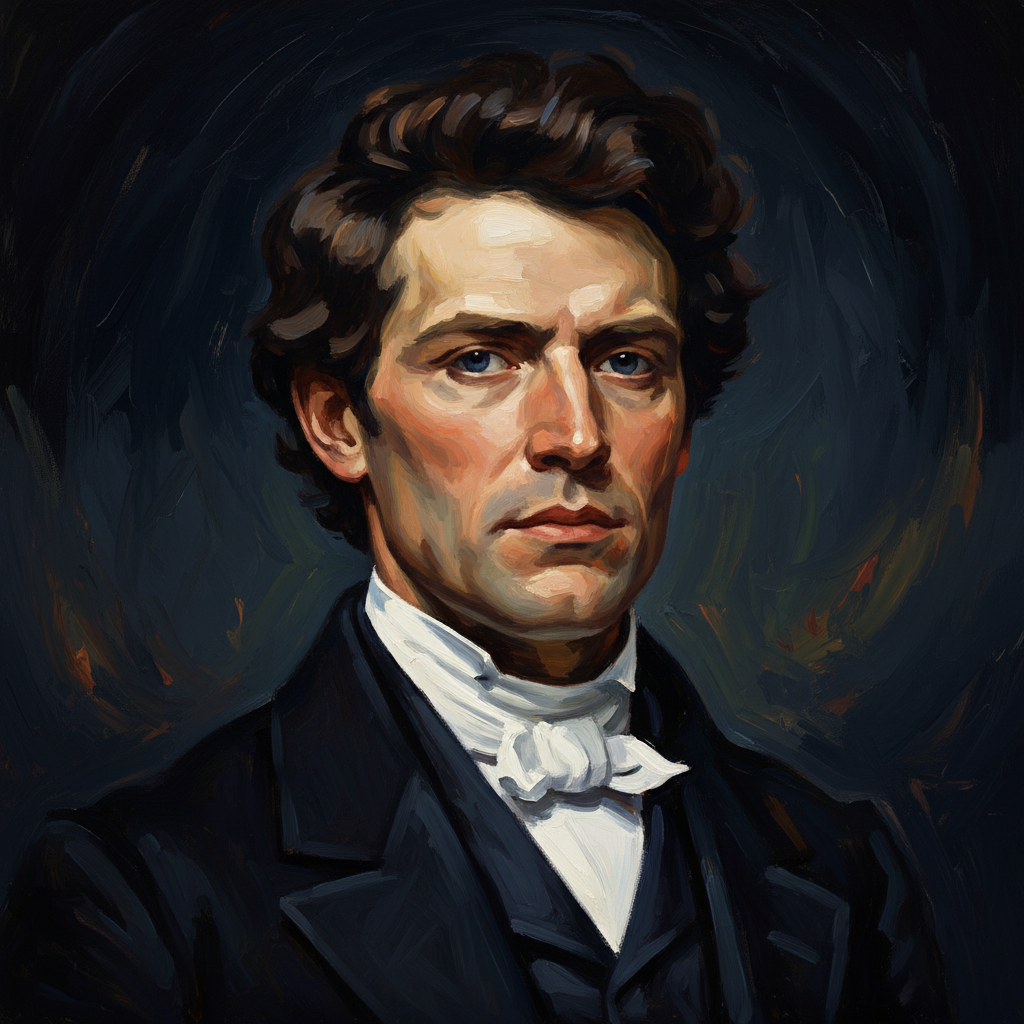
Joseph Smith — "I have been in the midst of more wickedness and persecution than any man living."
I have been in the midst of more wickedness and persecution than any man living.
I have been in the midst of more wickedness and persecution than any man living.
Click any product to generate a realistic preview. Up to 3 at a time.
* Initial load can take up to 90 seconds — revising the preview in another color is nearly instant.
"I combat the errors of ages; I meet the violence of mobs; I cope with illegal proceedings from executive authority; I cut the Gordian knot of powers, and I solve mathematical problems of universities,…"
"I am a Lover of the Constitution of the United States."
"I am a rough stone. The sound of the hammer and chisel is continually upon me. I desire the voice of the Lord to ring in my ears, and I am willing to bear the consequence."
"I have a right to reveal all things, and to teach all things."
"I combat the errors of ages; I meet the violence of mobs; I cope with the cunning of devils and all hell is enraged against me."
Found in 1 providers: grok
1 source checked
The speaker claims to have endured more evil, corruption, and deliberate opposition than any other person alive. It's a declaration of extreme suffering—not just personal hardship, but being surrounded by active hostility and moral darkness. The statement asserts unmatched resilience and a kind of martyrdom-in-life, framing his trials as uniquely severe and his endurance as extraordinary proof of his mission's significance.
Smith's life was defined by relentless conflict. He was tarred and feathered, repeatedly jailed on trumped-up charges, driven from Ohio, Missouri, and Illinois, and watched followers murdered and exiled. Missouri's Governor Boggs issued a literal extermination order against his people in 1838. Smith died at the hands of a mob in 1844. His self-image as a persecuted prophet paralleled biblical figures, reinforcing his divine calling through suffering.
The 1820s–1840s American frontier was violently hostile to unorthodox religious movements. Anti-Mormon sentiment was uniquely intense—mobs burned settlements, states expelled entire communities, and politicians openly endorsed violence. This era saw rising nativism, religious competition, and vigilante justice normalized. Smith's church challenged existing social hierarchies through communalism and polygamy, making him a target not just of bigotry but of genuine political and economic fear among established communities.
AI-generated insights based on extensive research and information for context. Factual errors? Email [email protected].
Your cart is empty