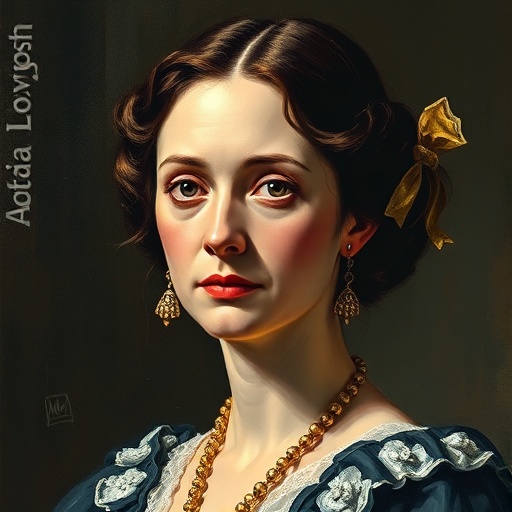
Ada Lovelace — "I have been so much occupied with my studies that I have neglected my social dut…"
I have been so much occupied with my studies that I have neglected my social duties.
I have been so much occupied with my studies that I have neglected my social duties.
Click any product to generate a realistic preview. Up to 3 at a time.
* Initial load can take up to 90 seconds — revising the preview in another color is nearly instant.
"I have a powerful imagination, and I use it to explore the possibilities of science."
"The Analytical Engine is capable of developing any operation that can be expressed by a finite and determinate number of symbols."
"I am not afraid to venture into unknown territory."
"I am a woman of science, and I am proud of it."
"It is quite clear that the Engine may be used as an aid to the human mind in calculating results, rather than merely performing arithmetic operations."
Found in 1 providers: grok
1 source checked
Intense, consuming work has crowded out the social obligations one is expected to fulfill. The speaker admits, without full apology, that deep study took priority over visiting, corresponding, and showing up for others. In modern terms, it captures the familiar tension between being absorbed in demanding intellectual work — research, a project, a deadline — and the guilt of neglecting friends, family, or community responsibilities that accumulated in the meantime.
Ada Lovelace, born 1815, collaborated with Charles Babbage on the Analytical Engine, producing notes containing the first published algorithm — work requiring extraordinary mental focus. As Countess of Lovelace, she bore real aristocratic social duties: calls, correspondence, dinners. Her letters reveal she genuinely wrestled with balancing mathematical obsession against family and social life. Her mother Annabella actively pushed her toward mathematics, fearing she'd inherit Byron's artistic temperament, which itself sharpened this tension.
Victorian England expected women of Lovelace's class to anchor social life: morning calls, correspondence, charity work, and soirées were duties, not options. Intellectual ambition in women was tolerated but firmly secondary to domestic and social roles. The 1830s–1840s also saw early industrial science demanding new kinds of sustained, specialized attention — the birth of professional expertise — making Lovelace's admission a collision between emerging intellectual modernity and entrenched social expectations of aristocratic womanhood.
AI-generated insights based on extensive research and information for context. Factual errors? Email [email protected].
Your cart is empty