What it means
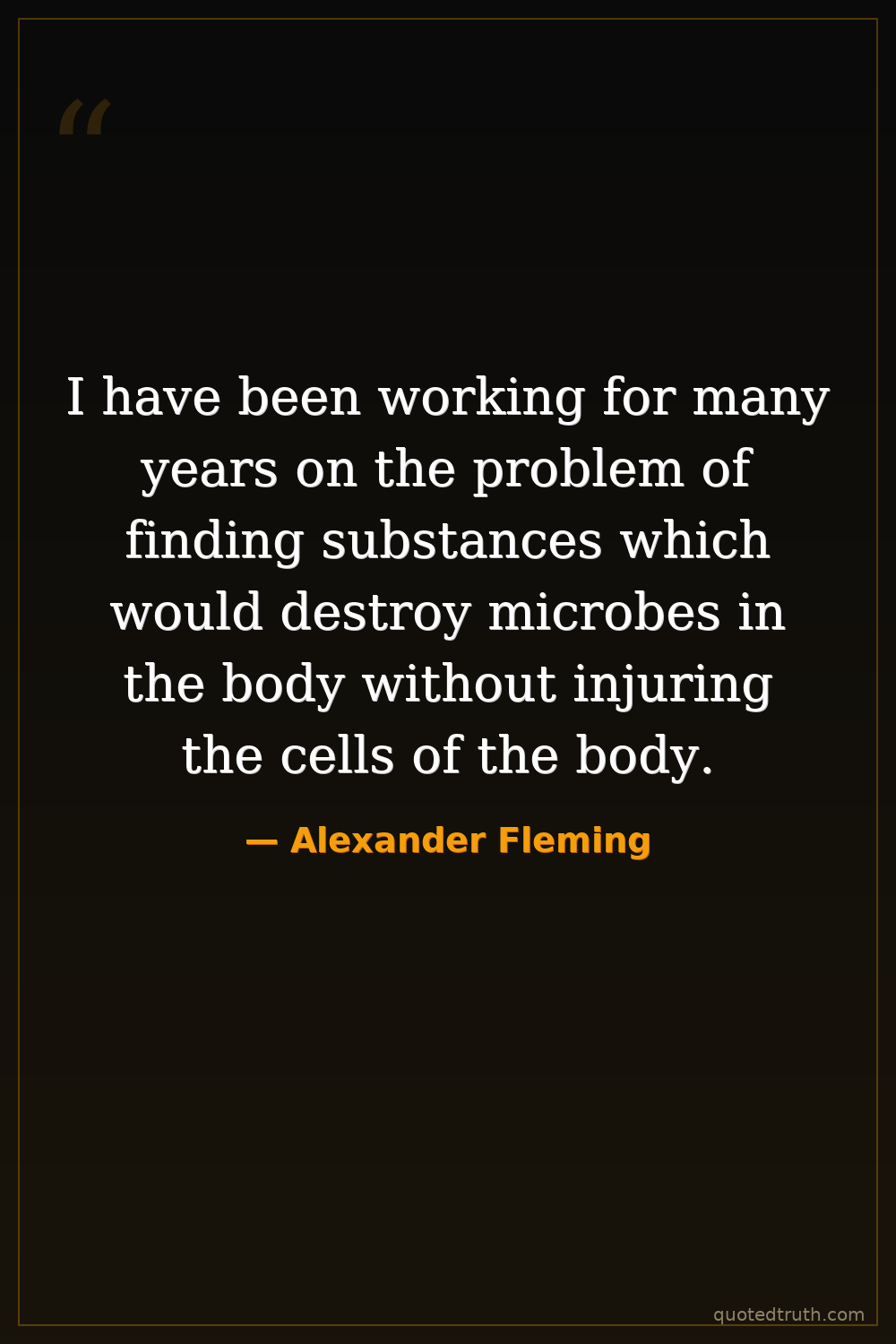
Fleming is describing decades of dedicated research aimed at finding a chemical that can kill harmful bacteria inside the human body without also damaging the patient's own healthy cells. This is the core challenge of antimicrobial medicine — selective toxicity. He's articulating the fundamental problem that drove his entire career: the invader and the host share similar biology, so how do you destroy one without harming the other?
Relevance to Alexander Fleming
Fleming spent decades at St. Mary's Hospital London under bacteriologist Almroth Wright, obsessing over wound infections. His 1921 discovery of lysozyme — an enzyme in tears and saliva that kills bacteria — was an early step toward this goal. His 1928 penicillin discovery, when mold contaminated a petri dish and killed surrounding bacteria, was the breakthrough answer to precisely this question. He shared the 1945 Nobel Prize for solving it.
The era
In the early 20th century, bacterial infections — pneumonia, sepsis, tuberculosis — were among the leading causes of death. World War I showed that infected wounds killed more soldiers than combat. Existing antiseptics like carbolic acid killed bacteria but destroyed surrounding tissue. There was no safe way to fight infection systemically. Fleming's era desperately needed a targeted bactericide, making his lifelong question one of medicine's most urgent unsolved problems.
AI-generated insights based on extensive research and information for context. Factual errors? Email [email protected].