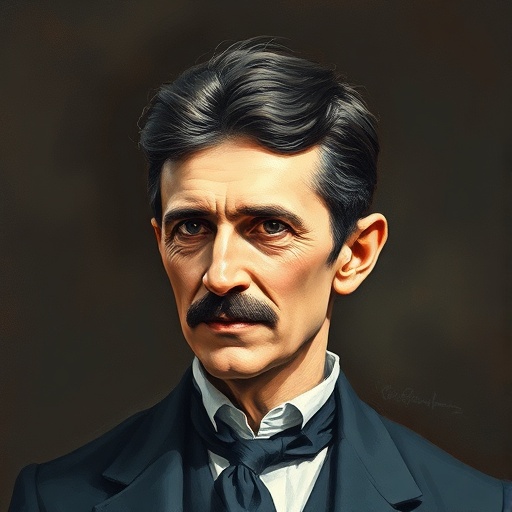
Nikola Tesla — "I have created a new form of energy, which I call the 'death ray.'"
I have created a new form of energy, which I call the 'death ray.'
I have created a new form of energy, which I call the 'death ray.'
Click any product to generate a realistic preview. Up to 3 at a time.
* Initial load can take up to 90 seconds — revising the preview in another color is nearly instant.
"The harness of the forces of nature is the only means of true progress."
"Even matter which is called inorganic, deemed dead, responds to the disbelievers and gives irrefutable proof of the living principle within itself. Everything that exists, organic or inorganic, living…"
"Let the future tell the truth and evaluate each one according to his work and accomplishments. The present is theirs; the future, for which I have really worked, is mine."
"The greatest discoveries have been made by men of science who have not been afraid to depart from the beaten path."
"Insufficient observation is only a form of unknowing, a cause of many perverse incidents and a triumph of crazy ideas."
Serbian-American inventor and electrical engineer whose alternating-current designs powered the modern electrical grid; died poor and largely forgotten. Closely associated with George Westinghouse (his AC-power business partner) and Mihajlo Pupin (fellow Serbian-American physicist at Columbia). For an intellectual contrast, see Thomas Edison, American inventor and direct-current advocate — Edison's direct-current power-distribution scheme was displaced by Tesla-Westinghouse AC in the 1890s 'War of Currents'. Edison ran a public-relations campaign electrocuting animals to discredit AC — the most famous engineering-ethics rivalry in American history. Tesla's AC won and powers nearly every electrical grid on Earth.
Found in 1 providers: grok
1 source checked
A claim to have invented a weapon — what Tesla called 'teleforce' — capable of projecting concentrated energy or particles across vast distances to destroy aircraft and armies without physical contact. In plain terms: a directed-energy weapon, ancestor of modern laser and particle-beam concepts. Tesla believed this technology would make conventional warfare obsolete by giving any nation an impenetrable defensive shield, deterring aggression through sheer destructive potential.
Tesla announced his death ray concept in 1934, aged 78, financially ruined and largely forgotten by the scientific establishment. Having lost control of his patents and never realized his Wardenclyffe Tower dream, he desperately sought funding and relevance. The death ray — grandiose, unverifiable, promising both destruction and peace — embodied his late-career pattern: genuine visionary thinking fused with increasingly unsubstantiated claims, reflecting a brilliant mind battling obscurity and poverty.
In the 1930s, Europe was rearming under fascist regimes while the Great Depression shattered economic confidence worldwide. Aerial bombardment had emerged as a terrifying new form of warfare, demonstrated in Spain's Civil War. Nations feared the next conflict would bring mass civilian death from the skies. Tesla's death ray concept — a defensive superweapon — resonated with an era desperately seeking technological deterrents before another catastrophic world war erupted.
AI-generated insights based on extensive research and information for context. Factual errors? Email [email protected].
Your cart is empty