What it means
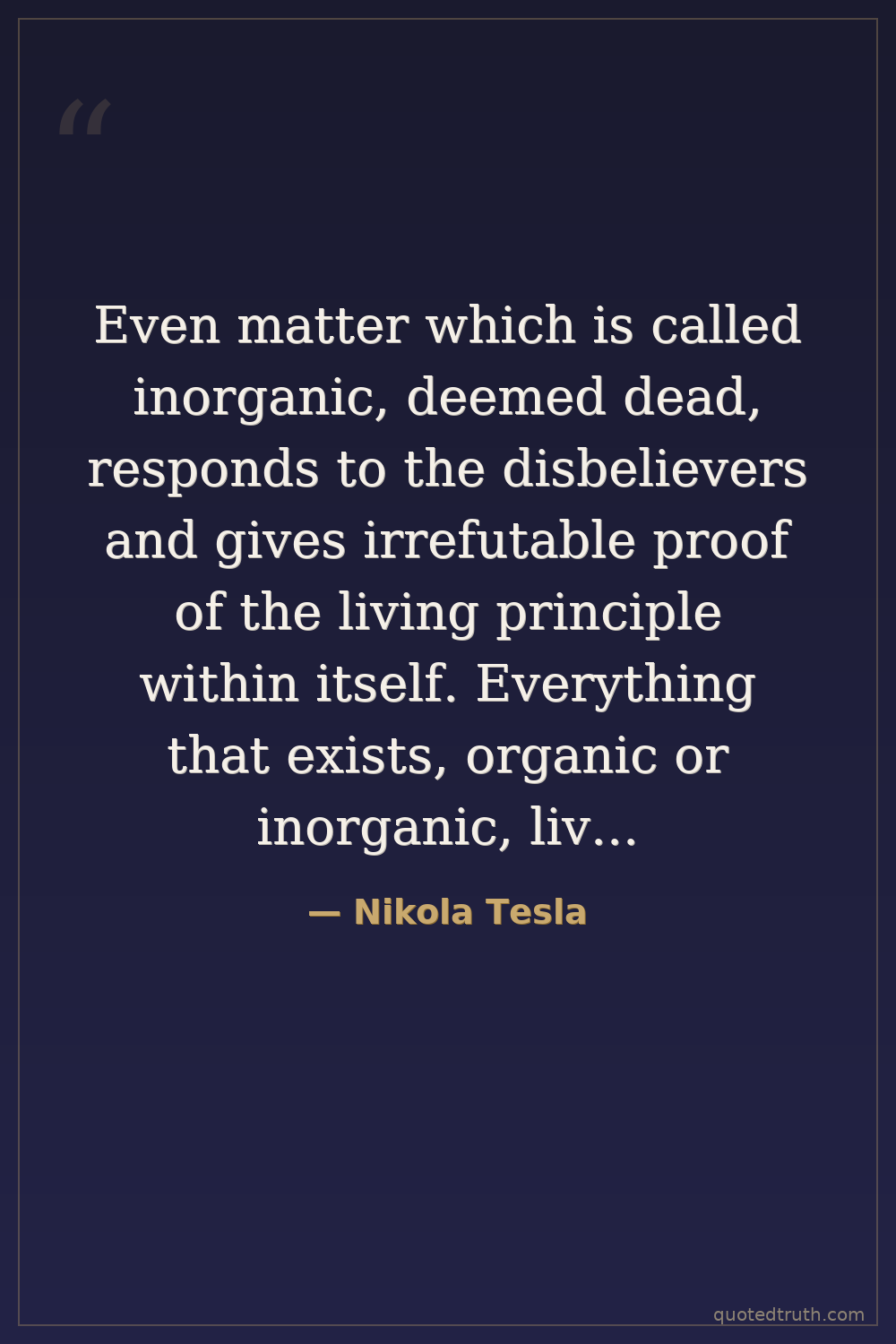
Tesla asserts that all matter — rocks, metals, gases — responds to external forces, proving a universal animating principle. Nothing is truly inert or dead; everything reacts to stimuli. He dissolves the hard boundary between living and non-living, arguing that responsiveness to outside influence is a fundamental property of all existence, not exclusive to biological life. It is a call to see the physical world as inherently dynamic and participatory rather than passive and mechanical.
Relevance to Nikola Tesla
Tesla's career hinged on coaxing responses from supposedly dead matter — copper wires conducting AC current, iron cores magnetizing, resonant frequencies shaking solid structures. His oscillator experiments proved buildings could vibrate to mechanical resonance. He envisioned a unified, electrically animate cosmos and wrote extensively of matter as fundamentally reactive. This quote mirrors his lifelong conviction that the barrier between animate and inanimate was an illusion born of incomplete observation, not a genuine feature of physical reality.
The era
Tesla lived through the late 19th-century collapse of classical vitalism — the doctrine that life required a supernatural force — after chemists synthesized organic molecules from inorganic ones. Simultaneously, electromagnetism revealed invisible fields acting on all matter. Fierce debates raged over whether physics could explain consciousness and life itself. Early quantum observations were also hinting that matter behaved in deeply non-classical ways, making Tesla's panvitalist intuition feel less mystical and increasingly aligned with emerging scientific frontiers.
AI-generated insights based on extensive research and information for context. Factual errors? Email [email protected].