What it means
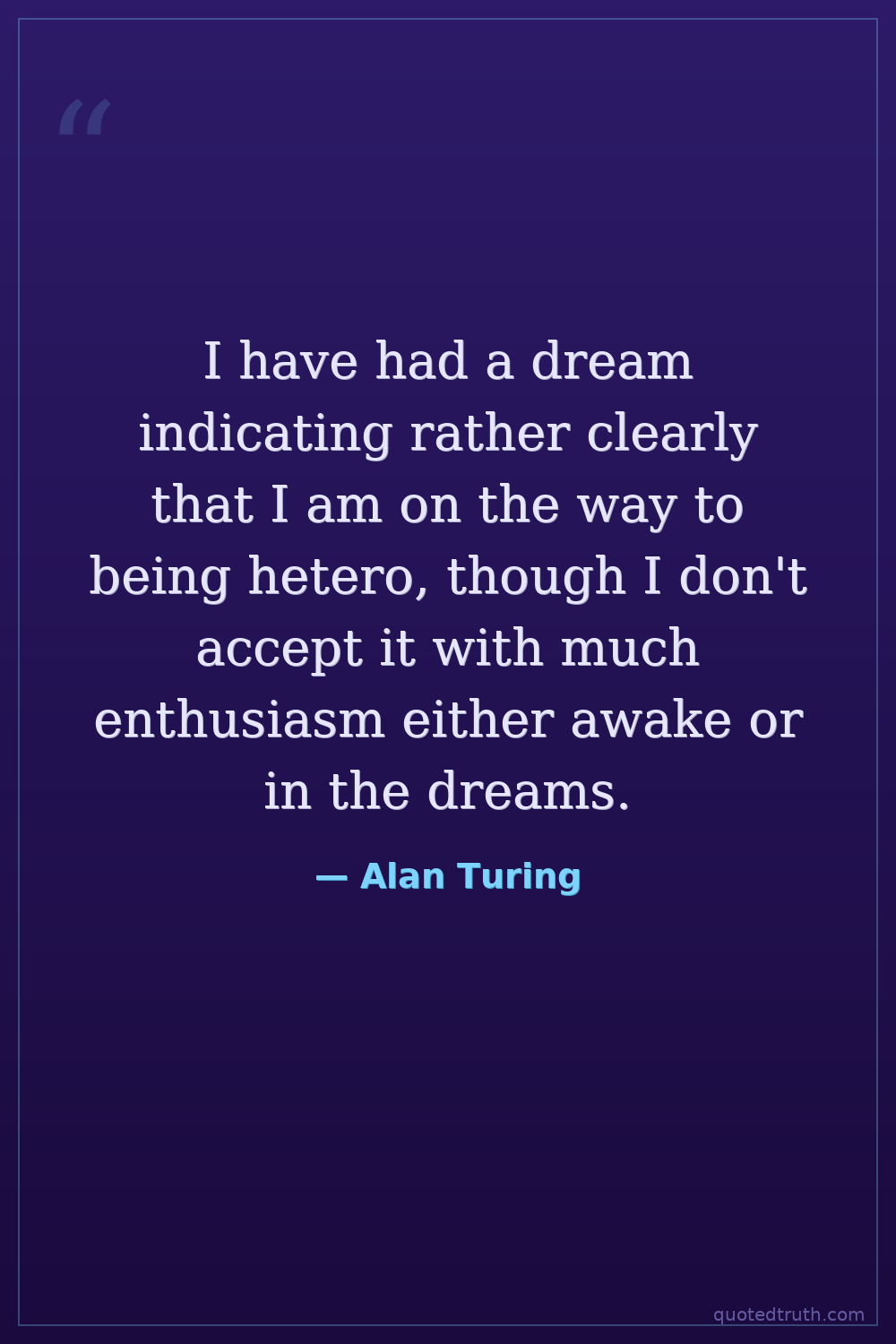
The speaker notes, with clinical detachment, that his dreams suggest a shift toward heterosexuality — then immediately undercuts it with stark honesty: he welcomes it with no enthusiasm. It's wry resignation, neither fighting the change nor grateful for it. He won't perform relief at the prospect of becoming straight. It captures the absurdity of being expected to want to change who you fundamentally are, even in your own unconscious mind.
Relevance to Alan Turing
In 1952, Turing was convicted of gross indecency and accepted chemical castration via estrogen injections to avoid prison. This quote reflects his characteristic precision — he observes his own psychological state like experimental data. The same mind that cracked Enigma and theorized machine intelligence now analyzed his forced transformation with mathematical detachment, refusing to feign the enthusiasm his persecutors presumably hoped state-mandated chemical treatment would eventually produce.
The era
Britain in the early 1950s criminalized homosexuality entirely. The Cold War cast gay men in sensitive roles as security threats, and Turing — vital to Allied victory at Bletchley Park — lost his security clearance and was prosecuted. Chemical castration was framed as a merciful alternative to prison, a medical cure. Two years after writing such letters, Turing died of cyanide poisoning in 1954, ruled a suicide widely attributed to consequences of state persecution.
AI-generated insights based on extensive research and information for context. Factual errors? Email [email protected].