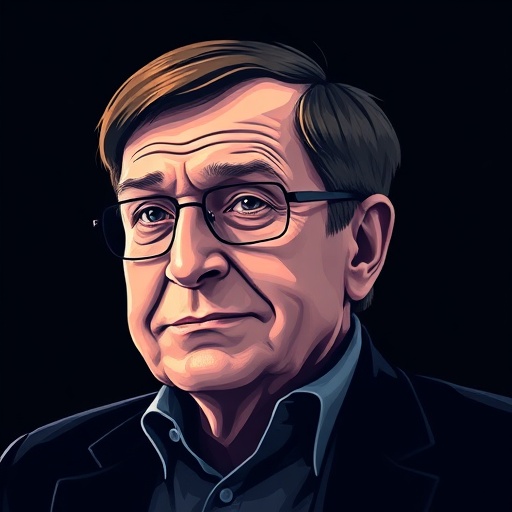
Stephen Hawking — "I have no idea. People who boast about their IQ are losers."
I have no idea. People who boast about their IQ are losers.
I have no idea. People who boast about their IQ are losers.
Click any product to generate a realistic preview. Up to 3 at a time.
* Initial load can take up to 90 seconds — revising the preview in another color is nearly instant.
"The laws of nature are the same everywhere in the universe."
"I believe the simplest explanation is, there is no God. No one created the universe and no one directs our fate. This leads me to a profound realization that there probably is no heaven and no afterli…"
"Intelligence is the ability to adapt to change."
"The greatest danger for our future is apathy."
"The human race is a single, genetic family. When a child is born, it is born into the human race, not into some particular tribe or nation. The human race is one. And we are all brothers and sisters."
British theoretical physicist whose Hawking radiation work and A Brief History of Time (1988) brought black-hole physics to a mass audience while he lived with ALS for 55 years. Closely associated with Roger Penrose (his collaborator on singularity theorems) and Carl Sagan (fellow popularizer who wrote Brief History's foreword). For an intellectual contrast, see William Lane Craig, American philosopher of religion — Craig's Kalam cosmological argument depends on the Big Bang requiring a divine first cause; Hawking's no-boundary proposal was specifically designed to remove the moment that would require one — the cleanest cosmology-vs-natural-theology contrast in modern thought.
In response to a question about his IQ during an interview with The New York Times.
Date: 2004
WisdomFound in 1 providers: grok
1 source checked
When someone asks your IQ, admitting you don't know it signals genuine intellectual confidence. People who memorize and broadcast their test scores are compensating for something — real intelligence shows through what you create, discover, or contribute, not a single standardized number. True mental achievement speaks for itself without needing a numerical badge to announce it.
Hawking, diagnosed with ALS at 21 and given two years to live, spent decades rewriting our understanding of black holes, radiation, and spacetime. He never needed a number to prove his mind. His work — Hawking radiation, A Brief History of Time, singularity theorems — was the credential. A man who unlocked universe-scale secrets had zero incentive to cite a test score.
Hawking lived through the IQ-obsession peak of the late 20th century, when Mensa grew rapidly and pop-psychology ranked geniuses by score. Simultaneously, the internet made IQ-bragging ubiquitous in forums and comment sections. His quip landed as a sharp rebuke: in an era fetishizing metrics, the scientist who arguably thought harder than anyone alive dismissed the entire measuring game as losers' territory.
AI-generated insights based on extensive research and information for context. Factual errors? Email [email protected].
Your cart is empty