What it means
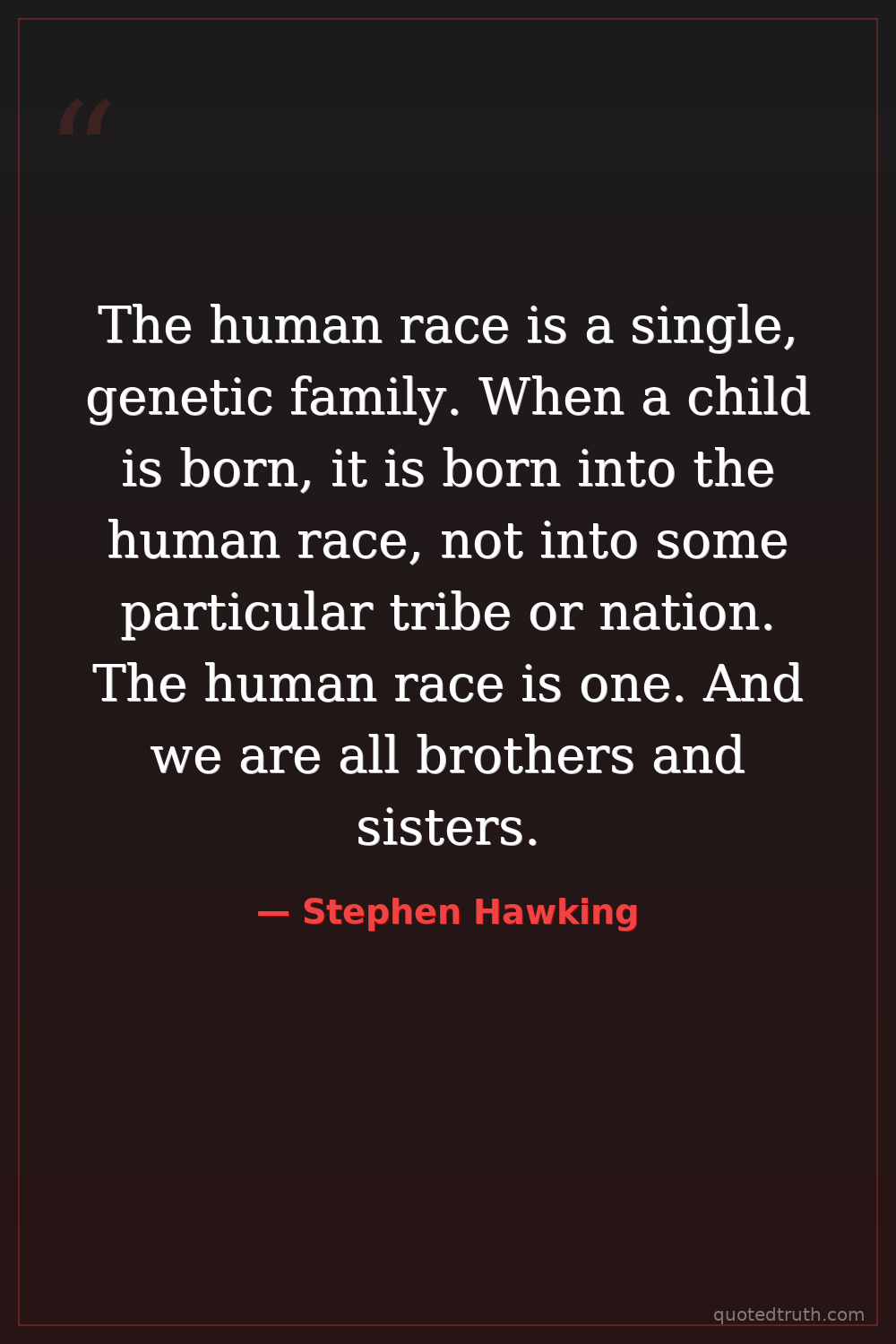
The quote argues that human beings share a common genetic heritage that transcends all political, national, and ethnic divisions. A child enters life as a member of humanity as a whole, not a subdivision. This universalist position calls for solidarity and empathy across all cultural and political borders, insisting that our biological kinship is a hard scientific fact, not a sentimental metaphor. Tribal identity is secondary to species identity.
Relevance to Stephen Hawking
Hawking spent his career studying the cosmos at the grandest scales—black holes, the Big Bang, the nature of time—a perspective that renders national borders trivial. Living with ALS for over fifty years, he relied on international collaborators and traveled the world despite profound disability. His scientific humanism and repeated warnings about existential threats including nuclear war, climate change, and AI reflected a deep concern for humanity as a unified whole.
The era
Hawking's most influential years (1970s–2018) coincided with globalization's rise and backlash. The Cold War divided humanity into ideological blocs; decolonization reshaped national identities; and by the 2010s, Brexit, nationalist populism, and immigration crises tested cosmopolitan ideals. Simultaneously, the Human Genome Project confirmed how genetically similar all humans are. Against that backdrop, asserting genetic unity carried both scientific authority and political urgency.
AI-generated insights based on extensive research and information for context. Factual errors? Email [email protected].