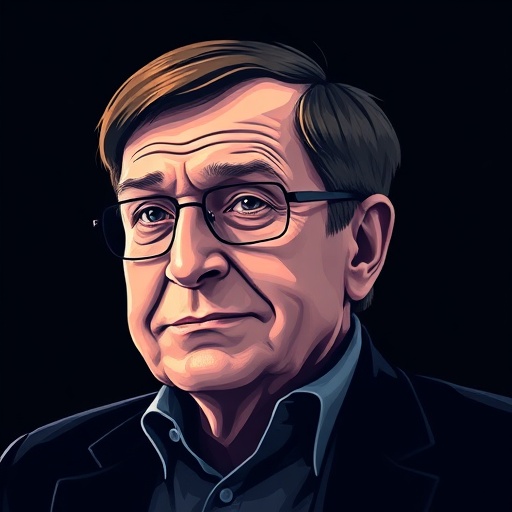
Stephen Hawking — "I have no idea what the universe is for, but I'm glad it's here."
I have no idea what the universe is for, but I'm glad it's here.
I have no idea what the universe is for, but I'm glad it's here.
Click any product to generate a realistic preview. Up to 3 at a time.
* Initial load can take up to 90 seconds — revising the preview in another color is nearly instant.
"I had a heart attack earlier this year... the ambulance took me to PC world for repairs."
"The greatest enemy of knowledge is not ignorance, it is the illusion of knowledge."
"The greatest achievement of the human race would be to understand the universe."
"I have no idea what the future holds, but I'm optimistic."
"Intelligence is the ability to adapt to change."
British theoretical physicist whose Hawking radiation work and A Brief History of Time (1988) brought black-hole physics to a mass audience while he lived with ALS for 55 years. Closely associated with Roger Penrose (his collaborator on singularity theorems) and Carl Sagan (fellow popularizer who wrote Brief History's foreword). For an intellectual contrast, see William Lane Craig, American philosopher of religion — Craig's Kalam cosmological argument depends on the Big Bang requiring a divine first cause; Hawking's no-boundary proposal was specifically designed to remove the moment that would require one — the cleanest cosmology-vs-natural-theology contrast in modern thought.
Found in 1 providers: grok
1 source checked
The universe's purpose remains unknown and perhaps unknowable, yet existence itself is worth celebrating. This expresses genuine wonder without requiring answers — embracing mystery as a feature rather than a flaw. Intellectual honesty and gratitude coexist: we don't need cosmic justification to appreciate that something exists rather than nothing, and that appreciation itself carries profound meaning.
Hawking spent his career probing the universe's deepest mechanics — singularities, Hawking radiation, the no-boundary proposal — yet never claimed to know *why* any of it existed. Diagnosed with ALS at 21 and given two years to live, he worked for five more decades. His gratitude for existence was lived, not theoretical. He found joy in the cosmos despite, or because of, its indifference.
Hawking's active career spanned the Cold War space race through the Hubble era and the discovery of dark energy, a period when physics repeatedly revealed a vaster, stranger, more purposeless-seeming universe. As religious authority declined in Western science culture and existential questions grew sharper, his willingness to sit comfortably with 'I don't know why' modeled a mature scientific humility increasingly needed.
AI-generated insights based on extensive research and information for context. Factual errors? Email [email protected].
Your cart is empty