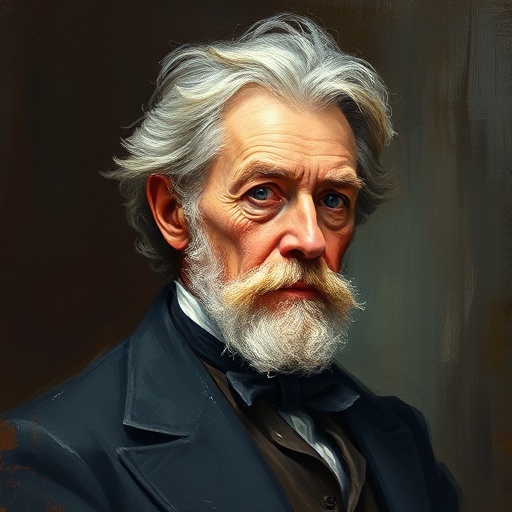
Michael Faraday — "I have no other guide than the truth, and I will follow it wherever it leads."
I have no other guide than the truth, and I will follow it wherever it leads.
I have no other guide than the truth, and I will follow it wherever it leads.
Click any product to generate a realistic preview. Up to 3 at a time.
* Initial load can take up to 90 seconds — revising the preview in another color is nearly instant.
"The true scientist is a man who is always learning, and never assumes that he knows everything."
"The world little knows how many of the thoughts and theories which have passed through the mind of a scientific investigator have been crushed in silence and secrecy by his own severe criticism and ad…"
"I shall be as patient as I can."
"The book of nature is written in the language of mathematics."
"The more I study, the more I am convinced of the existence of God."
Attributed, emphasizing his unwavering commitment to scientific truth.
Date: Mid 19th Century (approx.)
WisdomFound in 1 providers: grok
1 source checked
The speaker refuses to let authority, tradition, popularity, or personal preference dictate conclusions. Only evidence and honest reasoning determine direction, even when those findings contradict established views or prove personally inconvenient. Following truth means accepting wherever the investigation ends up, rather than steering toward a preferred outcome. It is a commitment to intellectual honesty above comfort, reputation, or loyalty to prior beliefs.
Faraday embodied this principle as a self-taught bookbinder's apprentice who rose to revolutionize physics through rigorous experimentation. A devout Sandemanian Christian, he rejected knighthood and prestigious Royal Society presidency, preferring laboratory work. His discoveries of electromagnetic induction, benzene, and field theory came from patient, prejudice-free experiments, not theoretical speculation. He famously declined weapons research for the Crimean War, following conscience over patronage.
Faraday worked during the 19th-century Industrial Revolution, when science was professionalizing and splitting from religious natural philosophy. Victorian England celebrated empirical discovery yet still tied scientific authority to class and credentials. Debates raged over electricity, chemistry, and the unseen forces shaping industry. Faraday's humble origins and refusal to mathematize prematurely put him at odds with elite contemporaries, making his truth-above-all stance a radical assertion of evidence over social standing.
AI-generated insights based on extensive research and information for context. Factual errors? Email [email protected].
Your cart is empty