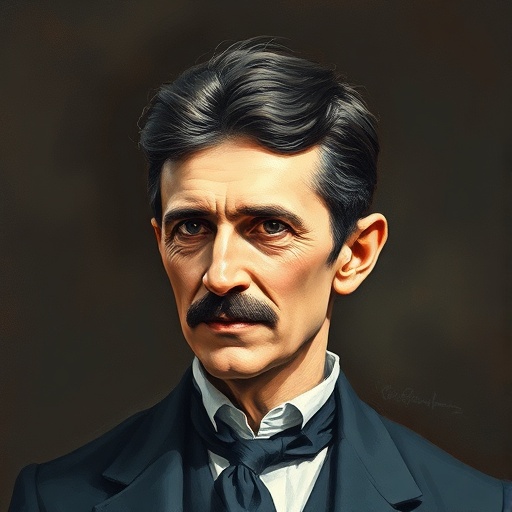
Nikola Tesla — "I have not married, so that I may devote myself entirely to my work."
I have not married, so that I may devote myself entirely to my work.
I have not married, so that I may devote myself entirely to my work.
Click any product to generate a realistic preview. Up to 3 at a time.
* Initial load can take up to 90 seconds — revising the preview in another color is nearly instant.
"I am unwilling to submit to any procedure for the determination of my mental condition."
"To know each other we must reach beyond the sphere of our sense perceptions."
"The day science begins to study non-physical phenomena, it will make more progress in one decade than in all the previous centuries of its existence."
"The spread of civilization may be likened to a fire; first, a feeble spark, then a flickering flame, then a mighty conflagration, fiercely glowing and devouring."
"As I review the events of my past life I realize how subtle are the influences that shape our destinies."
Serbian-American inventor and electrical engineer whose alternating-current designs powered the modern electrical grid; died poor and largely forgotten. Closely associated with George Westinghouse (his AC-power business partner) and Mihajlo Pupin (fellow Serbian-American physicist at Columbia). For an intellectual contrast, see Thomas Edison, American inventor and direct-current advocate — Edison's direct-current power-distribution scheme was displaced by Tesla-Westinghouse AC in the 1890s 'War of Currents'. Edison ran a public-relations campaign electrocuting animals to discredit AC — the most famous engineering-ethics rivalry in American history. Tesla's AC won and powers nearly every electrical grid on Earth.
Interview with Arthur Brisbane, 'When Woman Is Boss' (published in various newspapers)
Date: 1929
GeneralFound in 1 providers: grok
1 source checked
He chose lifelong bachelorhood as a deliberate sacrifice to maximize his dedication to scientific work. Tesla believed marriage and family life would divide his attention, energy, and focus. He framed personal renunciation not as loss but as a necessary condition for full creative output — a trade-off where romantic fulfillment was the price paid for complete immersion in invention and discovery.
Tesla remained a bachelor his entire life, living in hotels and pouring every waking hour into his lab. He worked obsessively — logging 18-hour days developing AC current, the Tesla coil, and wireless transmission. He genuinely believed intimate relationships would fragment his concentration. Late in life he reportedly grew close to a pigeon, suggesting profound loneliness alongside absolute commitment to his singular scientific mission.
Tesla worked during the Second Industrial Revolution, when electrifying civilization felt like a genuine race against time. The War of Currents pitted Tesla's AC system against Edison's DC monopoly. Patent battles, corporate competition, and the demand to prototype rapidly rewarded inventors who gave everything. The cultural ideal of the solitary genius sacrificing personal life for humanity's progress was widely romanticized, making Tesla's statement resonate as noble rather than tragic.
AI-generated insights based on extensive research and information for context. Factual errors? Email [email protected].
Your cart is empty