What it means
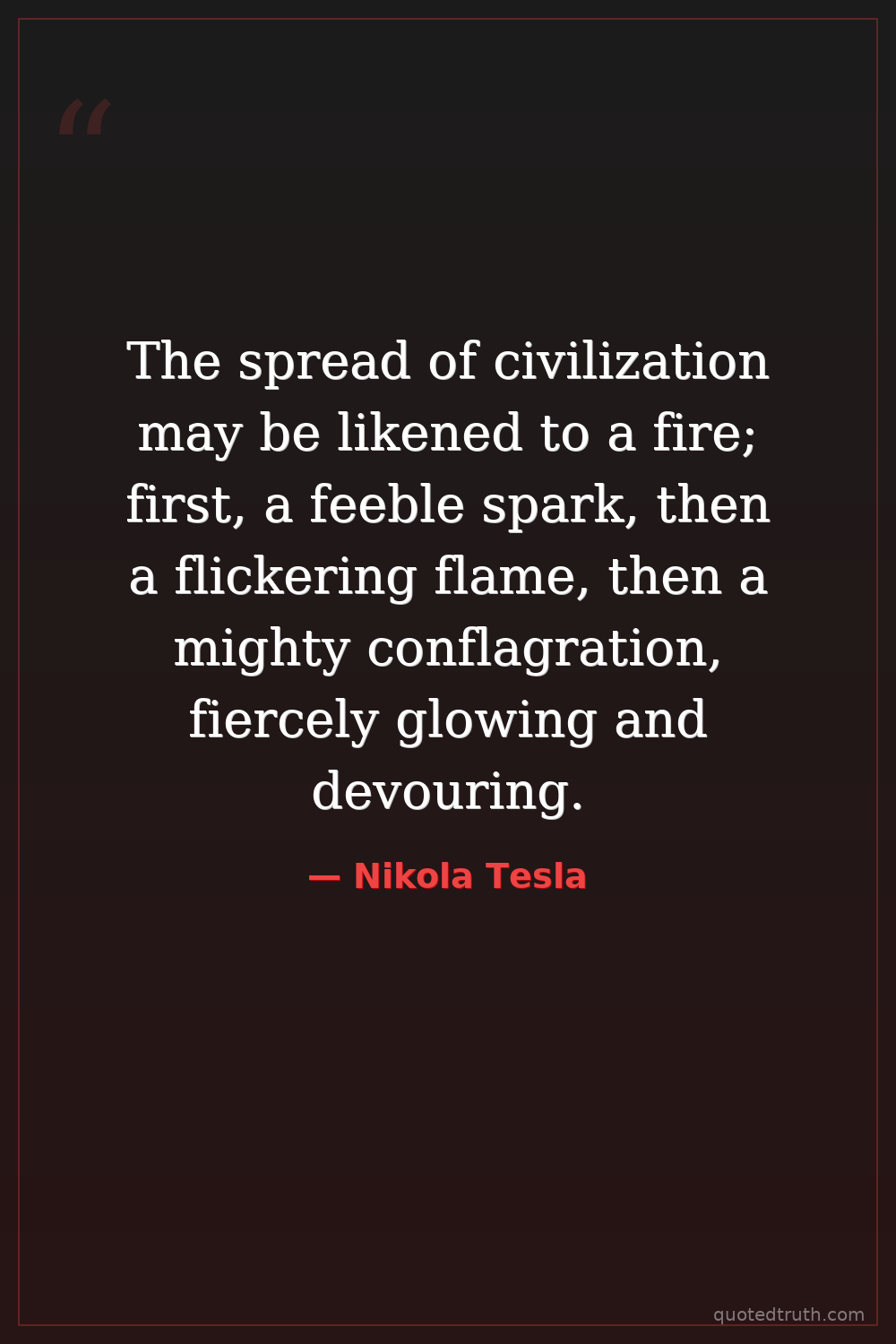
Civilization doesn't grow steadily — it ignites. What begins as a fragile idea or discovery builds through accumulated innovation until it becomes an overwhelming, unstoppable force. Progress accelerates exponentially: modest beginnings give way to explosive transformation that reshapes everything it touches. The old order gets consumed as fuel, leaving nothing untouched. A single spark — one invention, one insight — can eventually burn down and rebuild an entire world.
Relevance to Nikola Tesla
Tesla witnessed this arc firsthand. Alternating current began as a rejected idea dismissed by Edison — a feeble spark. It became a flickering flame through the War of Currents, then a conflagration lighting entire cities globally. His inventions — AC motors, the Tesla coil, radio foundations — were civilization's ignition points. Tesla believed science would transform humanity utterly, making this fire metaphor autobiographical: he saw himself as someone who struck the match that started an unstoppable blaze.
The era
Tesla wrote during the Second Industrial Revolution, when electricity was literally spreading across cities like fire. The 1880s–1910s saw railroads knit continents, telegraph networks circle the globe, and factories transform economies at breakneck speed. Optimism about technological progress was near-religious; thinkers genuinely believed science would solve every human problem. Yet industrialization also devoured — displacing workers, consuming resources, redrawing social orders. The metaphor captured both the wonder and the violence of an era remaking itself at unprecedented speed.
AI-generated insights based on extensive research and information for context. Factual errors? Email [email protected].