Wright Brothers (Orville & Wilbur) — "I have not the time for both a wife and an airplane."
I have not the time for both a wife and an airplane.
I have not the time for both a wife and an airplane.
Click any product to generate a realistic preview. Up to 3 at a time.
* Initial load can take up to 90 seconds — revising the preview in another color is nearly instant.
"The machine is practically ready for its public demonstration."
"We had no idea of the amount of publicity that would follow our flights."
"The aeroplane is not an invention, but a discovery."
"The greatest pleasure in life is to do what people say you cannot do."
"The air, like the sea, is an untamed element."
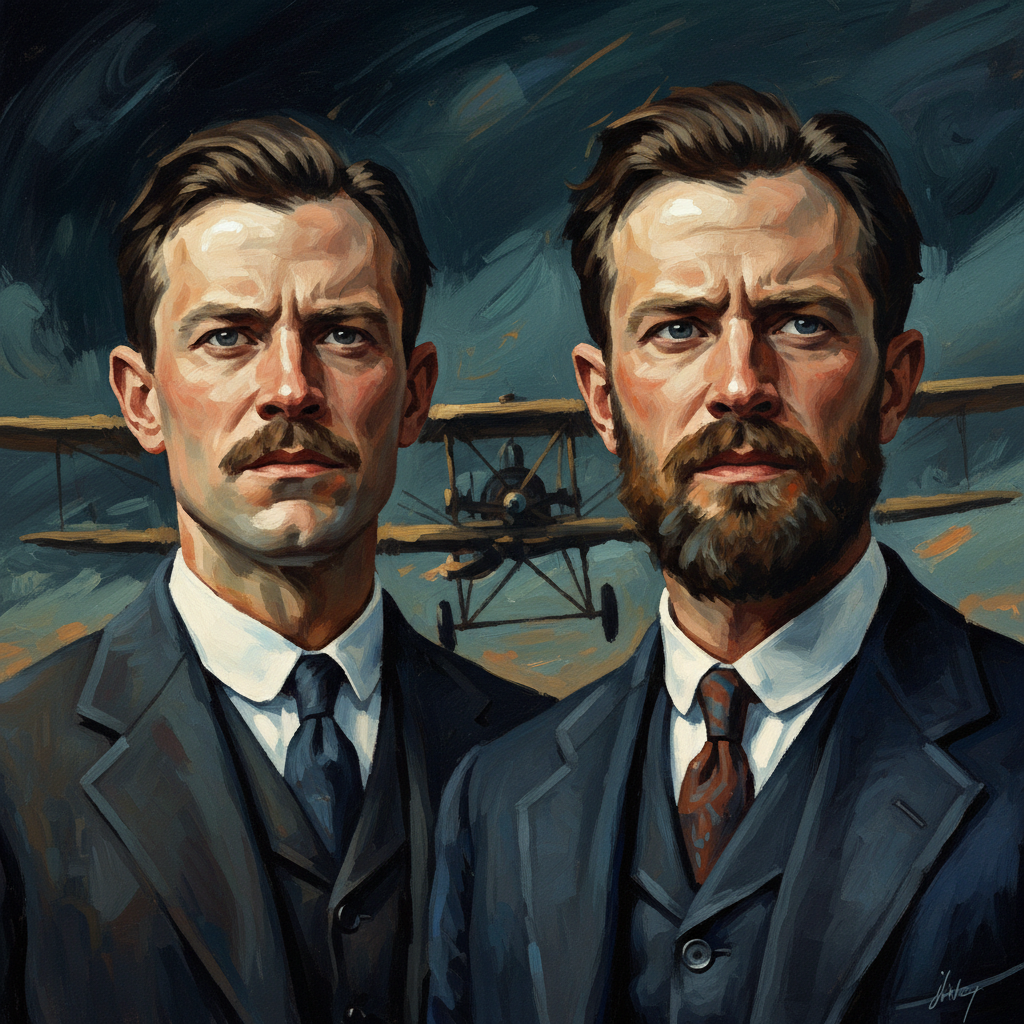
American aviation pioneers who achieved the first sustained powered controlled airplane flight at Kitty Hawk, NC, on December 17, 1903. Closely associated with Octave Chanute (their gliding mentor and aeronautical correspondent). For an intellectual contrast, see Samuel Pierpont Langley, Smithsonian Institution Secretary and government-funded aviation researcher — Langley's Aerodrome crashed twice into the Potomac in October-December 1903 with $50,000 of War Department funding; the Wright Brothers' bicycle-shop empiricism beat Langley's institutional Big Science by 9 days. The most-cited example in engineering history of empirical-tinkerer beating institution-funded credentialism.
Orville Wright, reflecting on his dedication to aviation
Date: Unknown, widely attributed
ShockingFound in 1 providers: gemini
1 source checked
The speaker is saying their work demands so much focus and energy that a serious romantic partnership would be impossible to sustain alongside it. Marriage and building an airplane each require full commitment, and trying to do both would shortchange one or the other. It is a blunt admission that a consuming creative project leaves no room for the obligations, attention, and presence a spouse would rightly expect.
Wilbur Wright said this, and he lived it: neither he nor Orville ever married, pouring their years into glider experiments at Kitty Hawk, wind-tunnel tests in Dayton, and the 1903 Flyer. They ran the family bicycle shop together, shared a home with sister Katharine, and treated aviation as an all-consuming engineering puzzle. Patent lawsuits and demonstration tours after 1903 consumed what little personal time remained, confirming the tradeoff he described.
At the turn of the 20th century, flight was considered fringe pseudoscience; Langley's funded attempts had publicly failed, and serious engineers dismissed heavier-than-air machines. The Wrights worked without university backing, government grants, or a research team, funding everything from bicycle sales. Victorian-era expectations still assumed men would marry young and support households, making Wilbur's choice a pointed rejection of convention in favor of solving a problem most contemporaries thought unsolvable.
AI-generated insights based on extensive research and information for context. Factual errors? Email [email protected].
Your cart is empty