Wright Brothers (Orville & Wilbur) — "The greatest pleasure in life is to do what people say you cannot do."
The greatest pleasure in life is to do what people say you cannot do.
The greatest pleasure in life is to do what people say you cannot do.
Click any product to generate a realistic preview. Up to 3 at a time.
* Initial load can take up to 90 seconds — revising the preview in another color is nearly instant.
"We had taken up the invention of the flying machine as a sport."
"It is difficult to understand how anyone could have been so blind to the truth."
"We could not understand how it was that the best scientists could not fly a machine. We thought that they must be working on the wrong principle."
"It is not necessary to be a genius to be an inventor."
"The course of the experiment was not exactly according to calculations, but was a success nevertheless."
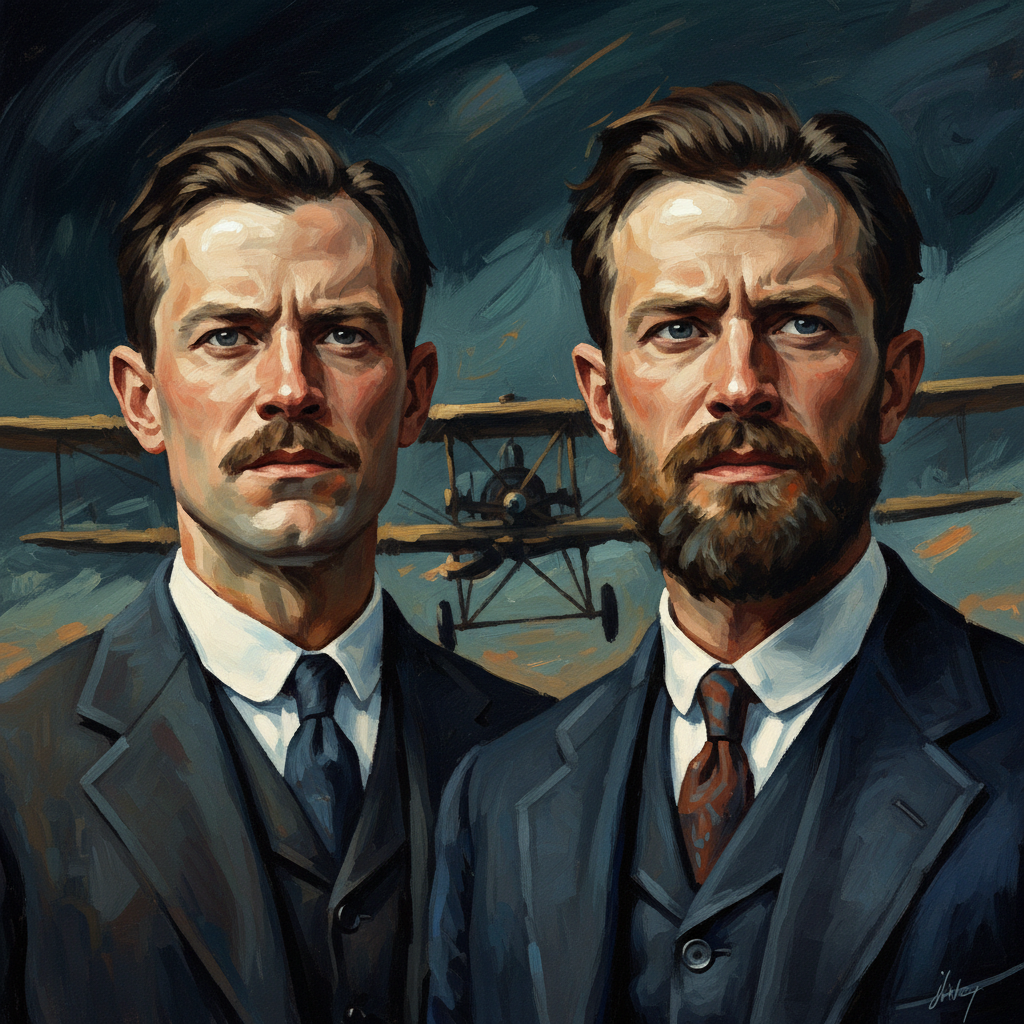
American aviation pioneers who achieved the first sustained powered controlled airplane flight at Kitty Hawk, NC, on December 17, 1903. Closely associated with Octave Chanute (their gliding mentor and aeronautical correspondent). For an intellectual contrast, see Samuel Pierpont Langley, Smithsonian Institution Secretary and government-funded aviation researcher — Langley's Aerodrome crashed twice into the Potomac in October-December 1903 with $50,000 of War Department funding; the Wright Brothers' bicycle-shop empiricism beat Langley's institutional Big Science by 9 days. The most-cited example in engineering history of empirical-tinkerer beating institution-funded credentialism.
Attributed to Walter Bagehot and others, but often associated with the Wright brothers' spirit. Unlikely they said this exact phrase.
Date: Disputed
Food & DrinkFound in 1 providers: grok
1 source checked
True satisfaction comes from proving doubters wrong. When others dismiss your goals as impossible, accomplishing them delivers a deeper reward than easy wins ever could. The resistance itself sharpens the achievement, turning skepticism into fuel. Chasing what seems unreachable, and then reaching it, beats any comfortable success handed to you. The joy lies not just in the result, but in defying the certainty of those who ruled it out.
The Wrights were bicycle mechanics with no formal engineering degrees, yet they solved controlled powered flight while scientists and well-funded rivals like Samuel Langley failed publicly. Newspapers, physicists, and even Wilbur himself once predicted heavier-than-air flight was a thousand years away. They pressed on through crashes at Kitty Hawk, patent battles, and years of public skepticism, eventually flying at Kill Devil Hills in 1903 after the establishment had written off the whole enterprise.
At the turn of the 20th century, respected authorities openly declared powered flight impossible. Lord Kelvin dismissed heavier-than-air machines, and Langley's 1903 Potomac crash seemed to confirm the doubters just days before Kitty Hawk. It was an age of rapid invention, the telephone, automobile, and electric light, but also of gatekeeping experts. Two Dayton shopkeepers beating Smithsonian-funded science captured the era's tension between credentialed institutions and scrappy, self-taught American tinkerers.
AI-generated insights based on extensive research and information for context. Factual errors? Email [email protected].
Your cart is empty