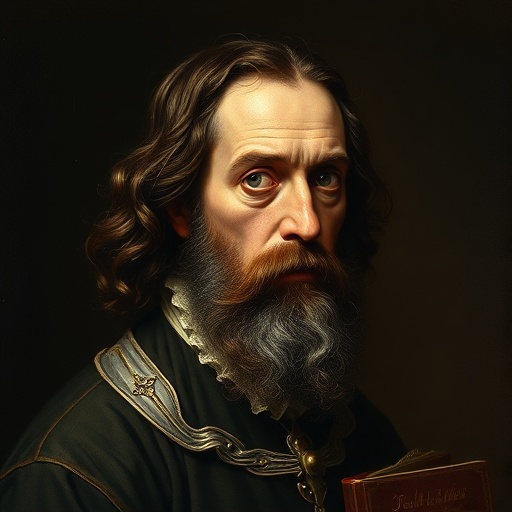
Johannes Kepler — "I have often been accused of being a dreamer."
I have often been accused of being a dreamer.
I have often been accused of being a dreamer.
Click any product to generate a realistic preview. Up to 3 at a time.
* Initial load can take up to 90 seconds — revising the preview in another color is nearly instant.
"I have been a mortal, and I have faced my own mortality with courage."
"I have been a fool, but I have learned from my folly."
"The road to truth is long and difficult."
"For a long time I was restless. Now, however, behold how through my effort God is being celebrated in astronomy."
"I am stealing the golden vessels of the Egyptians to build a tabernacle to my God from them, far far away from the boundaries of Egypt. If you forgive me, I shall rejoice; if you are enraged with me, …"
Found in 1 providers: grok
1 source checked
The speaker admits that others frequently call him impractical, fanciful, or detached from reality. He is acknowledging a common criticism leveled at him: that his ideas wander beyond what hard-headed people consider sensible or achievable. There is a quiet defensiveness in the phrasing, but also a refusal to apologize. He recognizes the label without rejecting the imaginative thinking that earned it.
Kepler pursued mystical convictions alongside rigorous math, believing planetary orbits encoded divine harmony and even sketching nested Platonic solids to explain spacing between worlds. His Mysterium Cosmographicum and Harmonices Mundi mixed astronomy with theology and music theory, drawing scorn from contemporaries who dismissed such speculation. Yet that same dreaming intuition pushed him past circular orbits to discover ellipses, producing the three laws of planetary motion that anchored Newton's later physics.
Early seventeenth-century Europe was caught between Aristotelian tradition and a shaky Copernican revolution; Galileo would soon face the Inquisition, and the Thirty Years' War scattered scholars. Patronage demanded astrologers more than astronomers, so Kepler cast horoscopes for Emperor Rudolf II to fund his real work. Imaginative speculation was suspect, hovering near heresy, yet it was precisely such 'dreaming' that pried natural philosophy loose from medieval certainty into modern empirical science.
AI-generated insights based on extensive research and information for context. Factual errors? Email [email protected].
Your cart is empty