What it means
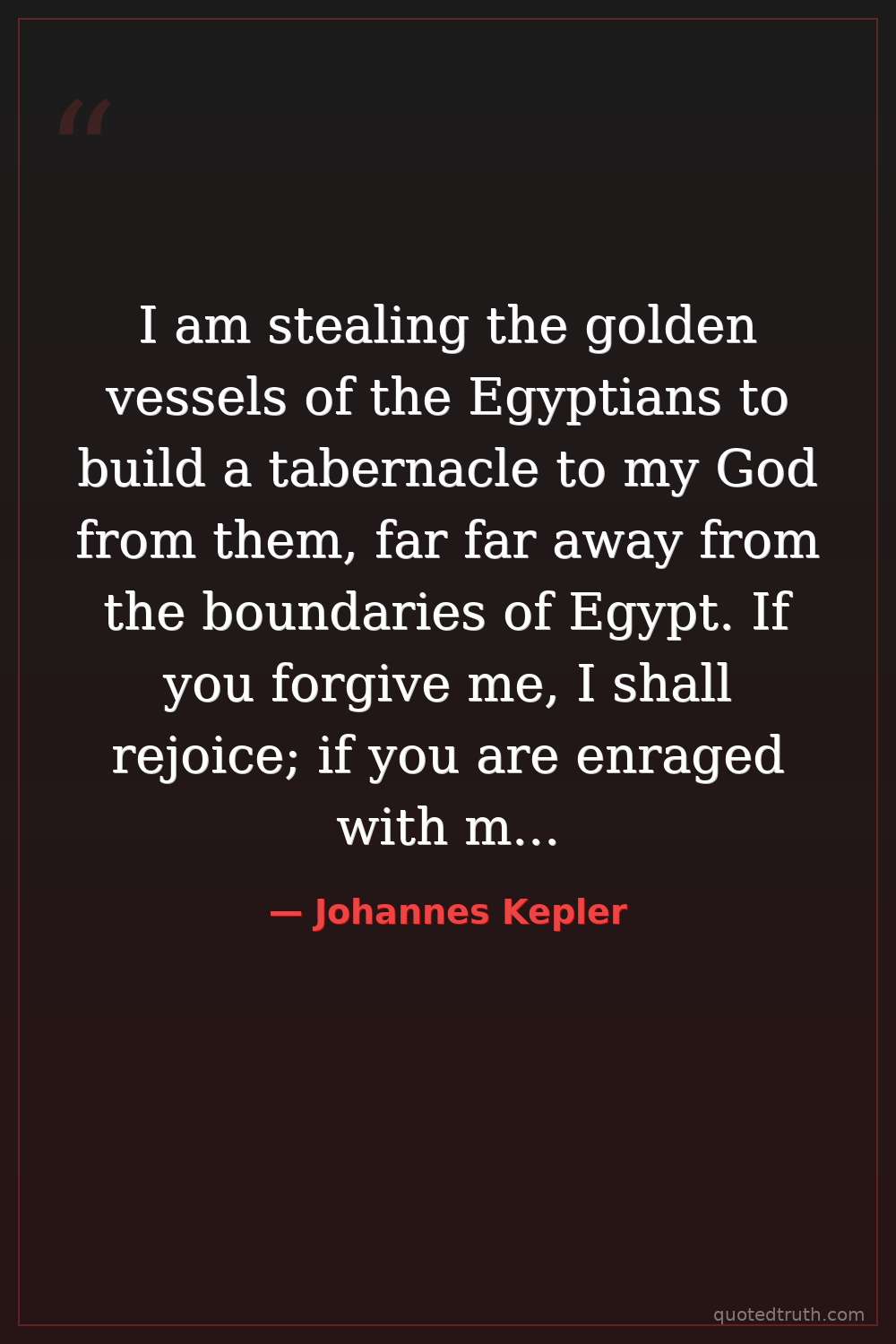
Kepler admits he is borrowing pagan Egyptian wisdom—astronomy, geometry, and mystical traditions—and repurposing it to honor the Christian God. He knows some readers will object to mixing ancient occult sources with sacred work, so he preemptively accepts their anger while hoping for understanding. Essentially: I am taking the good from other traditions to serve truth, and I will accept criticism for doing so.
Relevance to Johannes Kepler
Kepler was a devout Lutheran who saw astronomy as reading God's mind through mathematics. He drew heavily on Pythagorean harmonics, Hermetic mysticism, and pagan cosmology to formulate his planetary laws and Harmonices Mundi. This quote from that work defends his synthesis of sacred Christian purpose with 'heathen' Greek and Egyptian learning—exactly the methodological tension that defined his career as both imperial mathematician and theological seeker.
The era
In the early 1600s, the Counter-Reformation and Thirty Years' War made religious orthodoxy dangerous; Kepler was excommunicated by Lutherans and harassed by Catholics. Natural philosophers had to justify using pre-Christian sources against charges of paganism or heresy. Meanwhile, the Scientific Revolution was rediscovering Greek, Arabic, and Egyptian knowledge, forcing thinkers to reconcile ancient wisdom with Christian doctrine—a tension that defined the era's intellectual life.
AI-generated insights based on extensive research and information for context. Factual errors? Email [email protected].