What it means
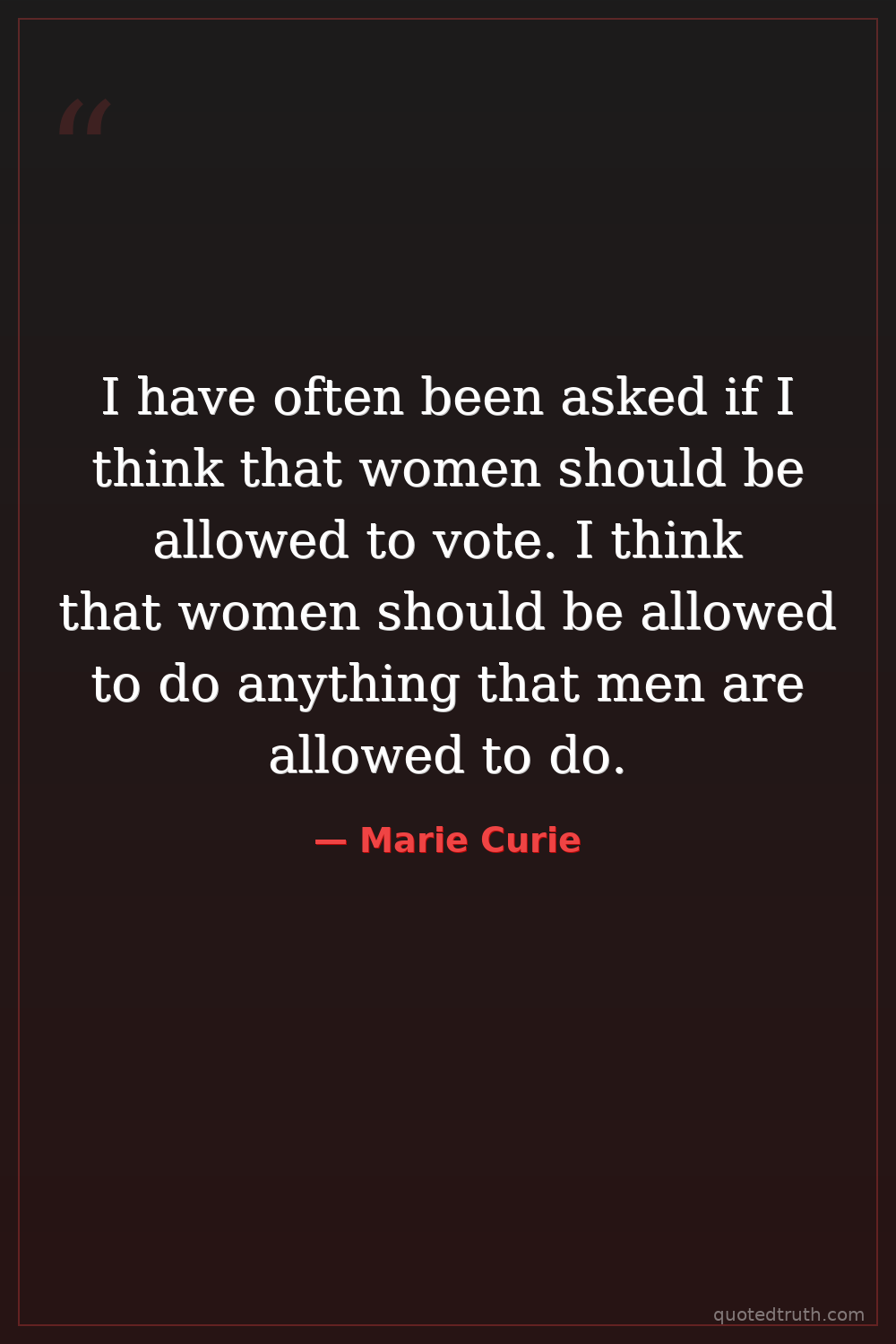
Curie argues that gender should not determine what activities or rights a person can access. If men are permitted to vote, work, study, or hold office, women deserve identical freedom. She rejects any framework that grants privileges to one sex while withholding them from the other, treating equality as the baseline rather than something women must earn or justify through special pleading.
Relevance to Marie Curie
Curie lived this claim. She fought to study physics at the Sorbonne when French universities barred most women, became the first woman to win a Nobel Prize, the first person to win two, and the first female professor at the Sorbonne. The French Academy of Sciences rejected her membership in 1911 purely because she was a woman, making her insistence on equal access personal, not abstract.
The era
Curie's era spanned fierce suffrage battles. British suffragettes were imprisoned and force-fed around 1910; French women would not vote until 1944, long after her death. Scientific institutions openly excluded women, and married women in many countries could not control property or earnings. Her fame gave weight to a position still considered radical, when most nations treated female citizenship as partial at best.
AI-generated insights based on extensive research and information for context. Factual errors? Email [email protected].