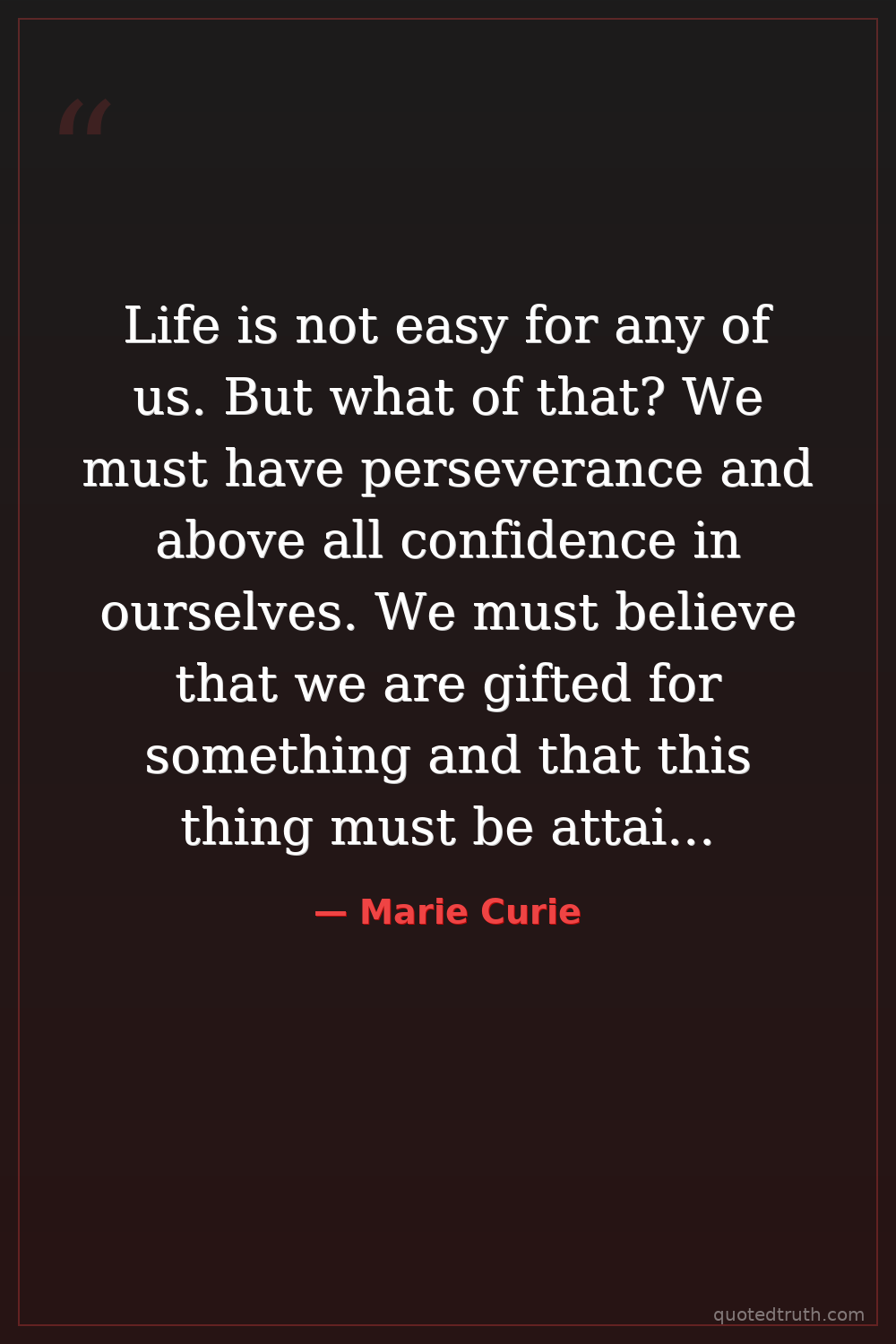
What it means
Nobody has an easy road, but that fact alone changes nothing about what you must do. Keep going, and more importantly, trust yourself. Believe you have a real talent or purpose, and commit to reaching it. Self-doubt and hardship are constants, so treating them as reasons to quit just guarantees failure. Persistence paired with genuine self-belief is the only way to actually arrive at whatever you were meant to accomplish.
Relevance to Marie Curie
Curie lived this literally. A poor Polish woman barred from universities at home, she studied in secret, moved to Paris, and survived on bread and tea while earning degrees. She processed tons of pitchblende by hand in a leaky shed to isolate radium, faced sexist rejection from the French Academy of Sciences, and still became the first person to win Nobel Prizes in two sciences. Perseverance and self-trust were not slogans for her; they were survival tools.
The era
Curie worked from the 1890s through the 1920s, when European women were largely excluded from universities, laboratories, and professional science. Warsaw under Russian rule banned Polish women from higher education entirely. Even in Paris, she was the first woman to earn a Sorbonne physics doctorate and the first to teach there. World War I, widowhood, and press scandals piled on. Telling herself and other women to believe in their gifts was a direct act of defiance.
AI-generated insights based on extensive research and information for context. Factual errors? Email [email protected].