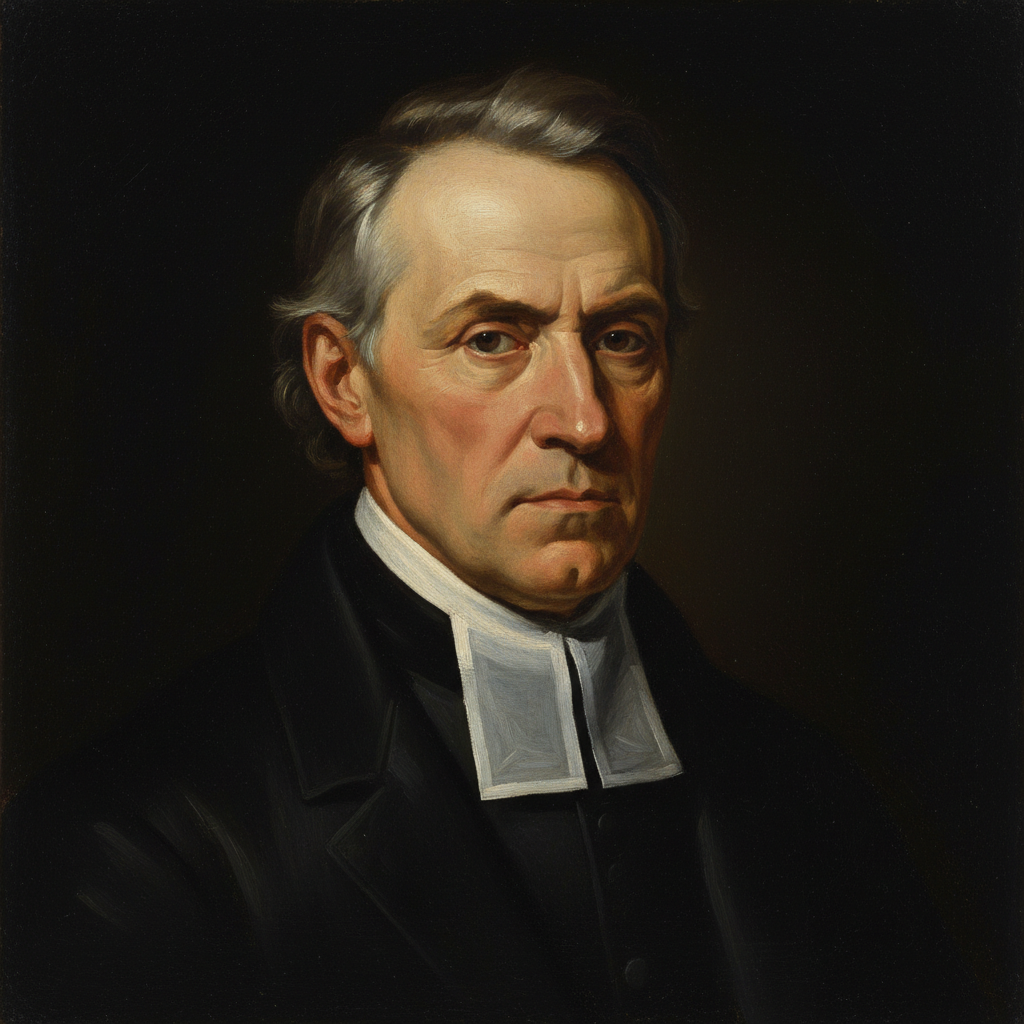
John Wesley — "I have often thought, that if I were to choose a way to travel, it should be on …"
I have often thought, that if I were to choose a way to travel, it should be on foot.
I have often thought, that if I were to choose a way to travel, it should be on foot.
Click any product to generate a realistic preview. Up to 3 at a time.
* Initial load can take up to 90 seconds — revising the preview in another color is nearly instant.
"Preach not doctrines, but Christ."
"I have often thought, that if I were to choose a place to preach in, it should be in the open air."
"The Methodists are a people who profess to pursue a Christian life by Scriptural rules and methods."
"The best of all is, God is with us."
"What a work has God wrought in our day!"
English Anglican cleric and founder of Methodism, whose open-air preaching and class-meeting structure created the largest 18th-century evangelical revival. Closely associated with Charles Wesley (his hymn-writing brother) and George Whitefield (early co-revivalist, later doctrinal opponent). For an intellectual contrast, see George Whitefield, Calvinist evangelical revivalist — Whitefield's predestinarian Calvinism vs Wesley's free-grace Arminian theology split the early Methodist movement permanently in the 1739-41 break. The founding evangelical Calvinist-Arminian schism — the two parallel evangelical traditions American Christianity descends from.
Found in 1 providers: grok
1 source checked
The speaker values walking as the ideal mode of travel, not merely for practicality but for the quality of experience it provides. Walking slows you down, connects you to the landscape and people around you, and keeps the traveler grounded and present. It prioritizes direct human engagement over speed or comfort, suggesting that the journey itself holds as much value as the destination.
Wesley literally walked and rode horseback across Britain for decades, covering an estimated 250,000 miles over his ministry career. He preached in open fields, visited miners, prisoners, and the poor—going to people rather than waiting for them. Walking embodied his theology of reaching ordinary people directly, not from behind a pulpit. His whole ministry was defined by constant movement among the working class.
In 18th-century Britain, travel was dangerous, expensive, and class-stratified—coaches were for the wealthy, and roads were notoriously poor. Wesley's era saw early industrialization uprooting rural communities. Choosing to walk rather than ride conveyed solidarity with the laboring poor who had no choice. It also reflected Enlightenment-era Romantic currents valuing nature, simplicity, and authentic experience over aristocratic convention.
AI-generated insights based on extensive research and information for context. Factual errors? Email [email protected].
Your cart is empty