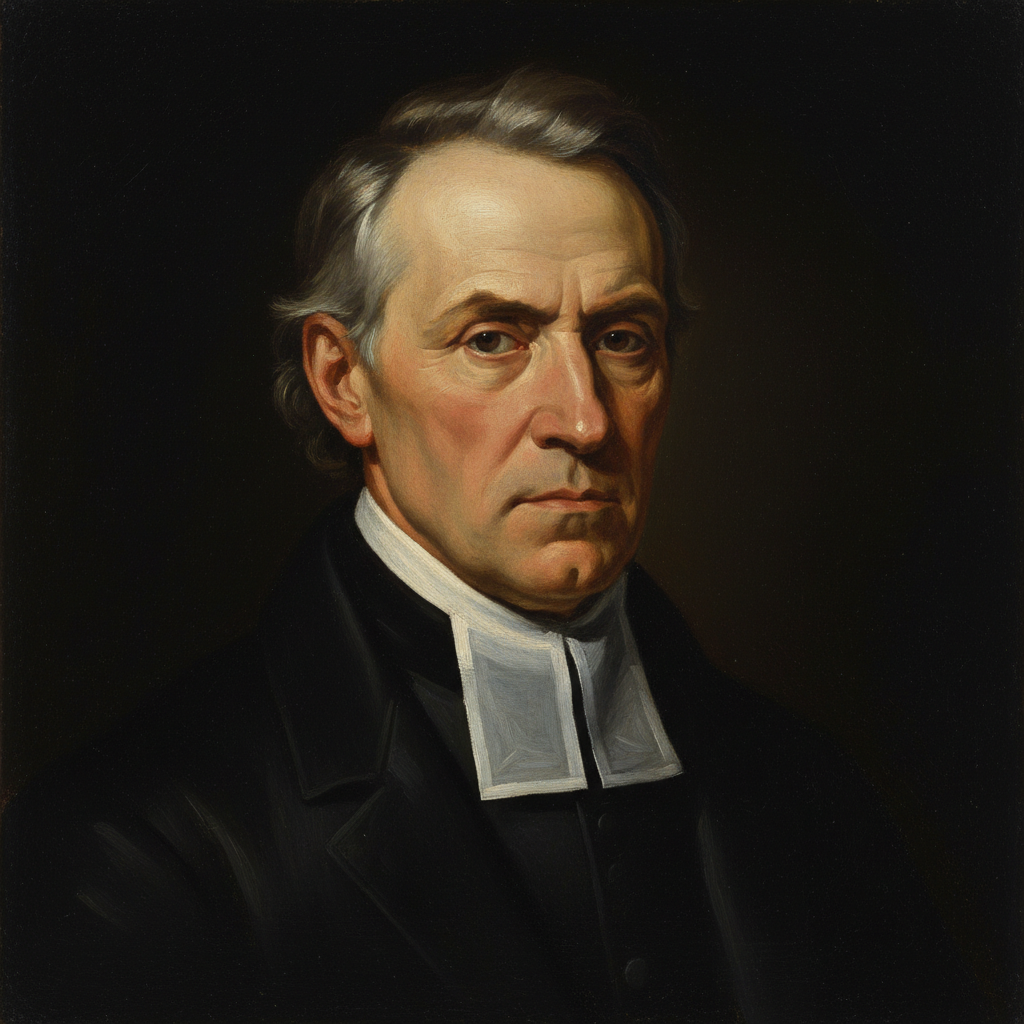
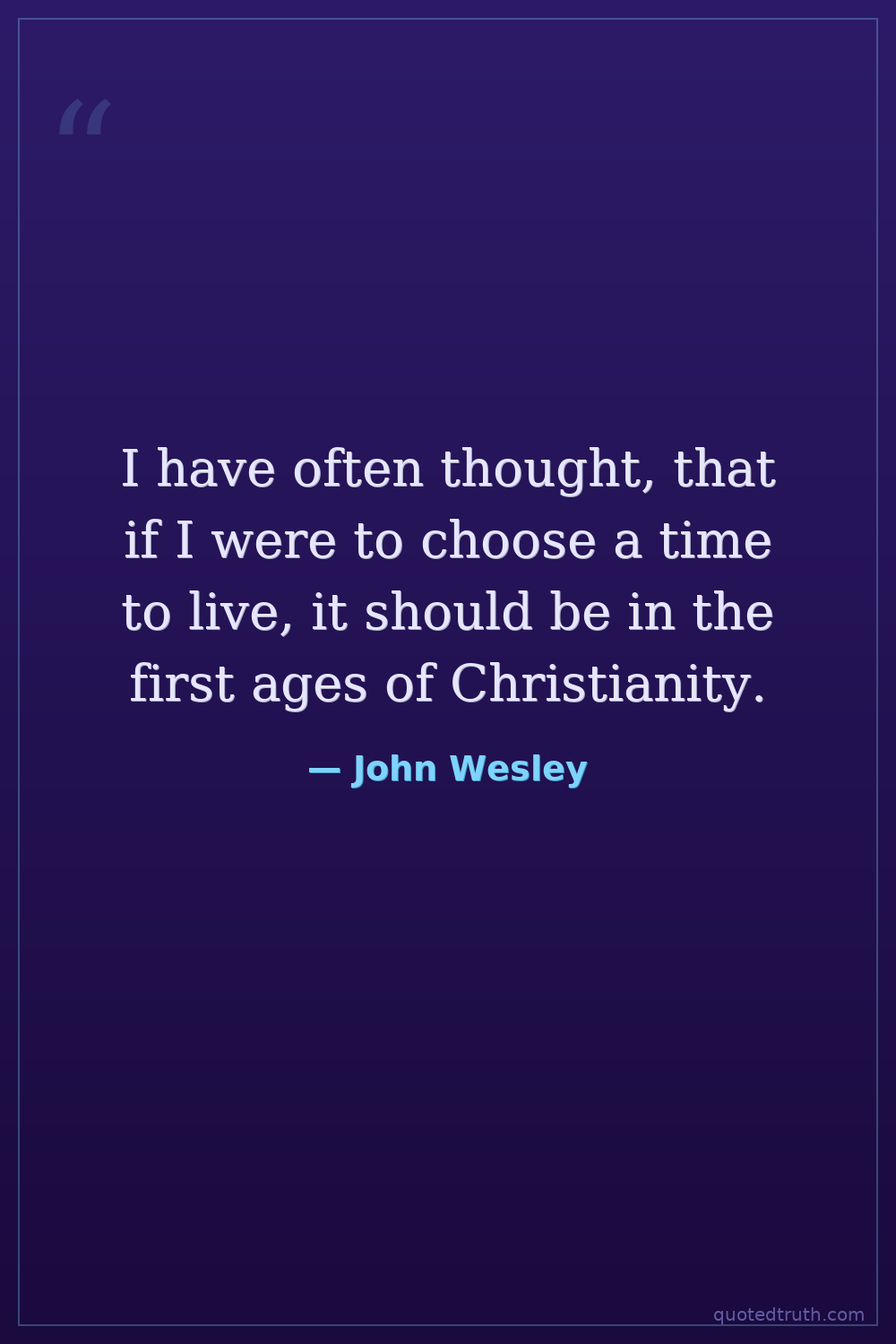
John Wesley — "I have often thought, that if I were to choose a time to live, it should be in t…"
I have often thought, that if I were to choose a time to live, it should be in the first ages of Christianity.
I have often thought, that if I were to choose a time to live, it should be in the first ages of Christianity.
Click any product to generate a realistic preview. Up to 3 at a time.
* Initial load can take up to 90 seconds — revising the preview in another color is nearly instant.
"I have often thought that the reason why so few are saved, is, because so few are willing to be saved."
"I know no other book in the world, that contains so many strong and clear proofs of the being and perfections of God, and of the truth of our holy religion, as the Bible."
"The Methodists do not desire to be distinguished from other men, but by the Spirit which they breathe."
"I have often thought, that if I were to choose a text to preach from, it should be 'God is love.'"
"The Lord is at hand; therefore fear not."
English Anglican cleric and founder of Methodism, whose open-air preaching and class-meeting structure created the largest 18th-century evangelical revival. Closely associated with Charles Wesley (his hymn-writing brother) and George Whitefield (early co-revivalist, later doctrinal opponent). For an intellectual contrast, see George Whitefield, Calvinist evangelical revivalist — Whitefield's predestinarian Calvinism vs Wesley's free-grace Arminian theology split the early Methodist movement permanently in the 1739-41 break. The founding evangelical Calvinist-Arminian schism — the two parallel evangelical traditions American Christianity descends from.
Found in 1 providers: grok
1 source checked
Wesley expresses a longing to have lived during the earliest period of Christianity — roughly the first two centuries after Christ. He believed that era represented the faith at its purest: small communities defined by radical love, sacrifice, and direct spiritual experience, uncorrupted by institutional power or doctrinal compromise. In modern terms, he wished he could have witnessed Christianity before organized religion accumulated centuries of politics, bureaucracy, and drift from its original simplicity.
Wesley's entire ministry was built on restoring what he saw as apostolic Christianity's heat and simplicity. Expelled from Anglican pulpits for preaching too urgently, he took to open fields — mimicking early Christians who gathered wherever they could. His 'class meetings,' small accountability groups for spiritual growth, deliberately echoed the intimate house churches of the first century. This quote explains his lifelong drive: not to innovate, but to recover lost authenticity.
Wesley lived during the Enlightenment, when educated Europeans increasingly dismissed traditional Christianity as superstition. The Church of England was widely seen as politically comfortable and spiritually inert — clergy held multiple paid posts while neglecting their flocks. Meanwhile, industrialization was uprooting England's working poor. Against this backdrop, Wesley's longing for the early church was both a critique of his present and a manifesto: the original faith had answers that his corrupted, rationalized era had lost.
AI-generated insights based on extensive research and information for context. Factual errors? Email [email protected].
Your cart is empty