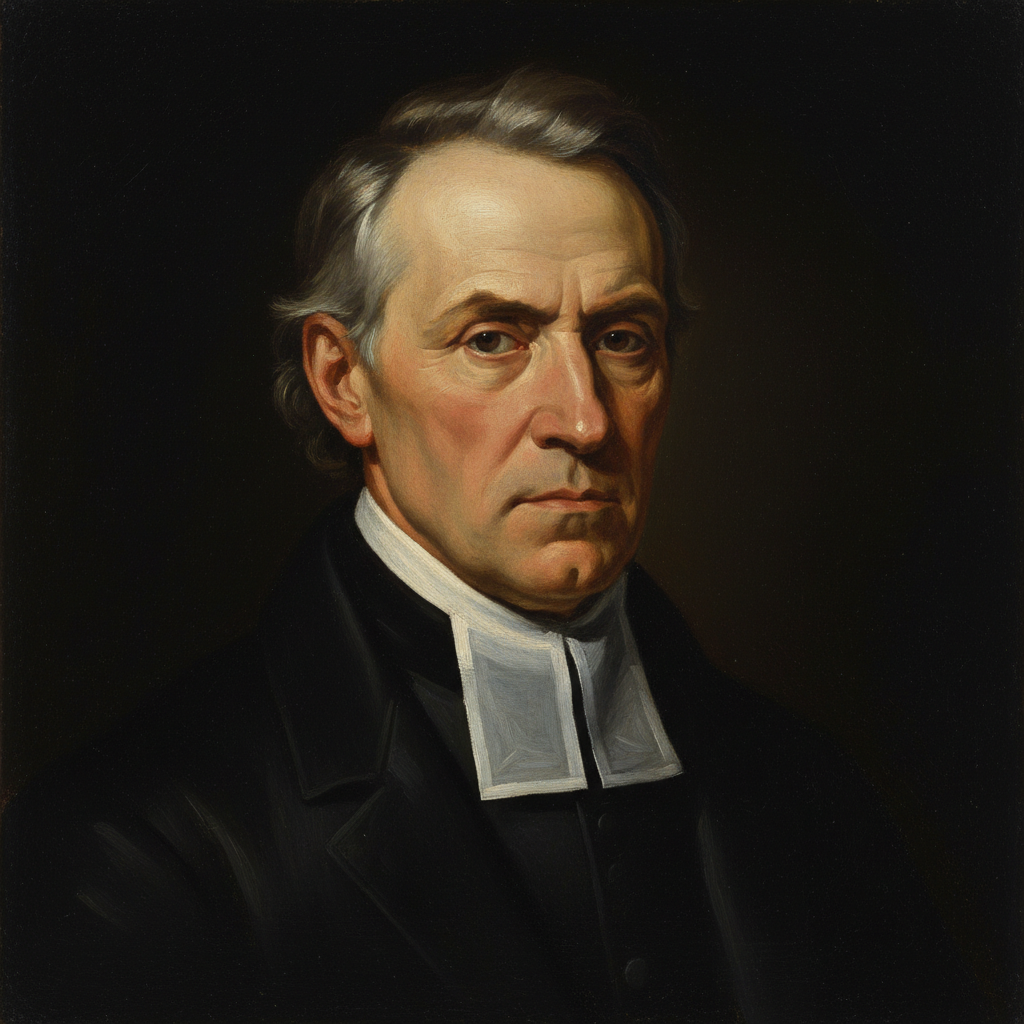
John Wesley — "The Lord is at hand; therefore fear not."
The Lord is at hand; therefore fear not.
The Lord is at hand; therefore fear not.
Click any product to generate a realistic preview. Up to 3 at a time.
* Initial load can take up to 90 seconds — revising the preview in another color is nearly instant.
"What is the secret of your strength? I answer, the power of prayer."
"I am not afraid of giving too much, but of giving too little."
"I have often wondered that any man, who has tasted of the pleasures of retirement, can ever be prevailed upon to quit them."
"I have not much time to spare for trifles."
"I have often thought, that the best way to do good, is to do it as if you were doing it for yourself."
English Anglican cleric and founder of Methodism, whose open-air preaching and class-meeting structure created the largest 18th-century evangelical revival. Closely associated with Charles Wesley (his hymn-writing brother) and George Whitefield (early co-revivalist, later doctrinal opponent). For an intellectual contrast, see George Whitefield, Calvinist evangelical revivalist — Whitefield's predestinarian Calvinism vs Wesley's free-grace Arminian theology split the early Methodist movement permanently in the 1739-41 break. The founding evangelical Calvinist-Arminian schism — the two parallel evangelical traditions American Christianity descends from.
Found in 1 providers: grok
1 source checked
Do not be afraid because God is present with you right now. This is a call to courage rooted in divine nearness rather than circumstances. It reframes fear as unnecessary when one recognizes that a powerful, caring God is actively close at hand, not distant or absent. Anxiety dissolves when presence replaces distance in one's understanding of the divine relationship.
Wesley founded Methodism amid fierce opposition, mob violence, and open-air preaching that required extraordinary courage. He rode over 250,000 miles on horseback, often threatened by hostile crowds. His theology centered on God's immediate, accessible grace for all people, not just the elite clergy. This conviction that God was genuinely near sustained his relentless, often dangerous evangelism across Britain and America.
Eighteenth-century Britain was marked by social upheaval, industrialization's early disruptions, rampant poverty, and spiritual deadness within the established Church of England. Common people lived with disease, economic insecurity, and political instability. Wesley's message of an immediately present God democratized faith for the laboring poor, offering tangible spiritual comfort when institutional religion felt cold, hierarchical, and indifferent to ordinary suffering.
AI-generated insights based on extensive research and information for context. Factual errors? Email [email protected].
Your cart is empty