Galileo Galilei — "I know that I am mortal, and that my life will pass away like a shadow; but I ho…"
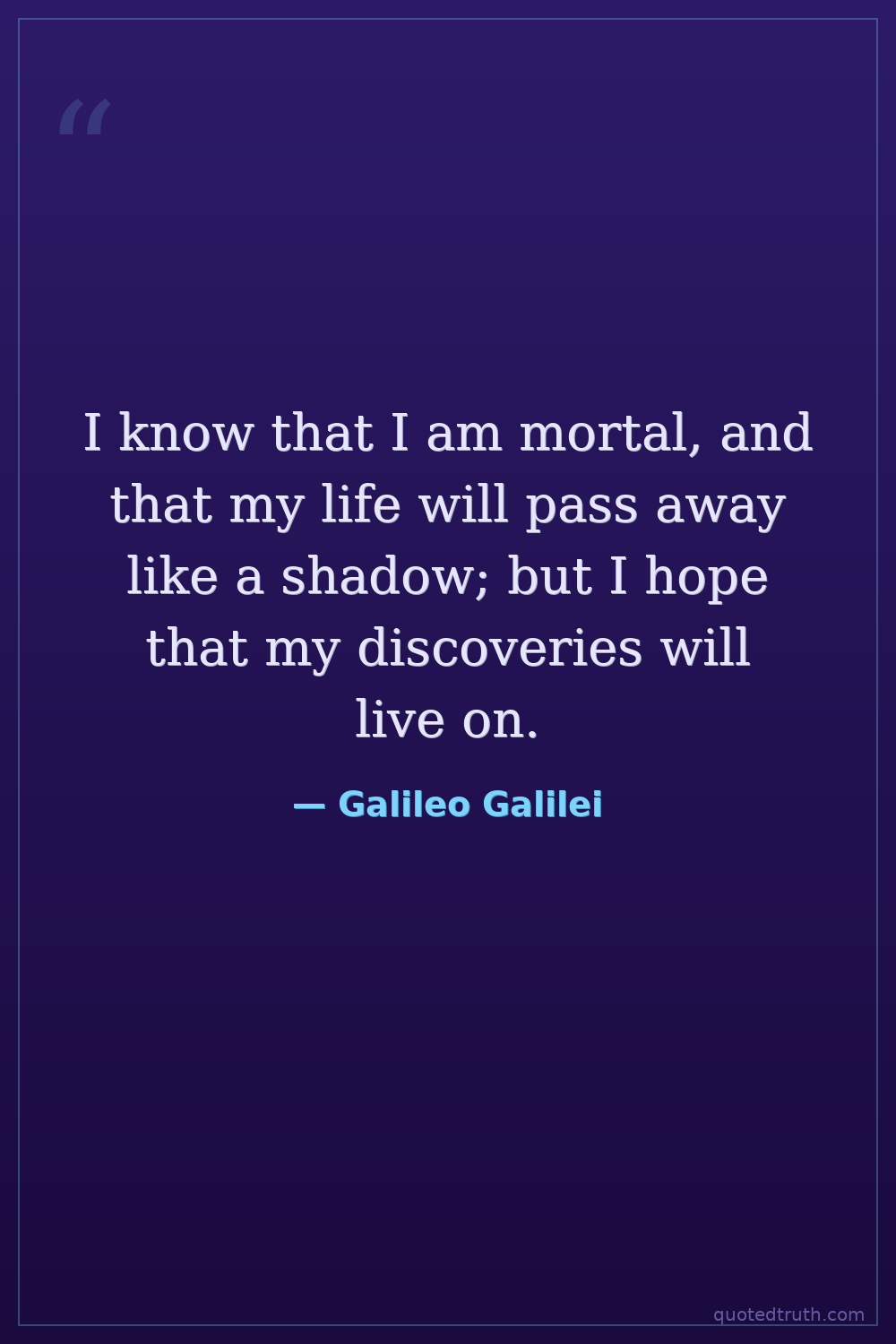
I know that I am mortal, and that my life will pass away like a shadow; but I hope that my discoveries will live on.
I know that I am mortal, and that my life will pass away like a shadow; but I hope that my discoveries will live on.
Click any product to generate a realistic preview. Up to 3 at a time.
* Initial load can take up to 90 seconds — revising the preview in another color is nearly instant.
"Nature does not make leaps."
"Facts which at first seem improbable will, even on scant explanation, drop the cloak which has hidden them and stand forth in naked and simple beauty."
"That man will be very fortunate who, led by some unusual inner light, shall be able to turn from the dark and confused labyrinths within which he might have gone forever wandering with the crowd and b…"
"I consider the sun's axial rotation to be an excellent argument for the diurnal rotation of the earth."
"It is a beautiful and admirable thing to search out the causes of natural phenomena."
Reflects his aspirations, but exact quote source is hard to verify.
Date: Uncertain
EducationalFound in 1 providers: grok
1 source checked
The quote expresses the universal human awareness of mortality balanced against the enduring power of ideas. The speaker acknowledges their finite existence — life brief as a shadow — but finds comfort in the belief that genuine contributions to knowledge outlast the individual. It's fundamentally about legacy: what one discovers or creates can transcend personal death and continue shaping the world long after the discoverer is gone.
Galileo Galilei (1564–1642) advanced observational astronomy and physics against fierce institutional resistance. He used the telescope to confirm heliocentrism, discovered Jupiter's moons, and formulated laws of motion — all while facing Inquisition censure. Forced to recant his findings in 1633 and confined to house arrest, he kept working regardless. This sentiment mirrors his lived reality: his personal freedom was stripped away, yet he trusted that his scientific truths would endure.
The early modern period was defined by a collision between ancient authority and new empirical science. The Catholic Church's geocentric worldview, rooted in Aristotle and scripture, held iron sway over intellectual life. The printing press spread ideas rapidly, yet the Inquisition could ban books and imprison thinkers. Whether discoveries survived depended on political and religious forces — making Galileo's hope that his work would outlast him both poignant and genuinely uncertain.
AI-generated insights based on extensive research and information for context. Factual errors? Email [email protected].
Your cart is empty