What it means
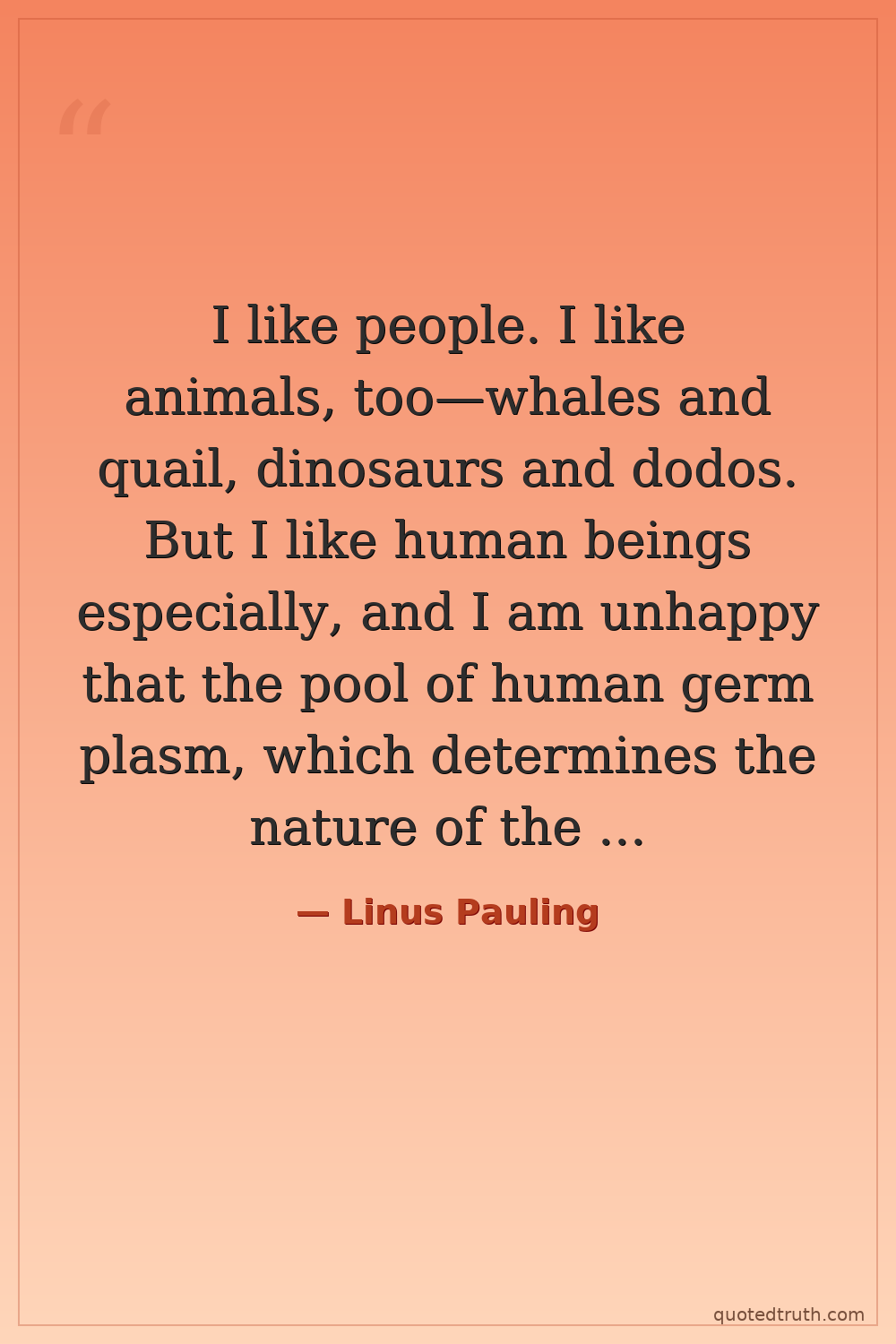
Deep affection for all living things frames a sharp alarm about humanity's genetic future. Germ plasm refers to the collective human gene pool — the inherited material passed between generations. Pauling argues this pool is being degraded, threatening the long-term quality of the species. His concern flows not from misanthropy but its opposite: love for people makes watching their genetic inheritance deteriorate personally anguishing.
Relevance to Linus Pauling
Pauling's dual Nobel prizes — Chemistry in 1954 and Peace in 1962 — grew from the same root: scientific rigor applied to human welfare. He understood radiation's mutagenic effects on DNA and campaigned relentlessly against atmospheric nuclear testing, arguing fallout was silently corrupting future generations' genetic inheritance. His 1958 petition, signed by 11,000 scientists, cited precisely this genetic damage, encapsulating how his love of humanity drove anti-nuclear political activism.
The era
During the 1950s and early 1960s, the US and Soviet Union conducted hundreds of atmospheric nuclear tests, spreading radioactive isotopes globally. Scientists increasingly understood that radiation caused mutations in germ cells, permanently altering future generations' DNA. Pauling was among the loudest scientific voices warning of this invisible genetic toll. The 1963 Partial Nuclear Test Ban Treaty, which he credited with vindicating his activism, represented the era's eventual reckoning with these hereditary consequences.
AI-generated insights based on extensive research and information for context. Factual errors? Email [email protected].