What it means
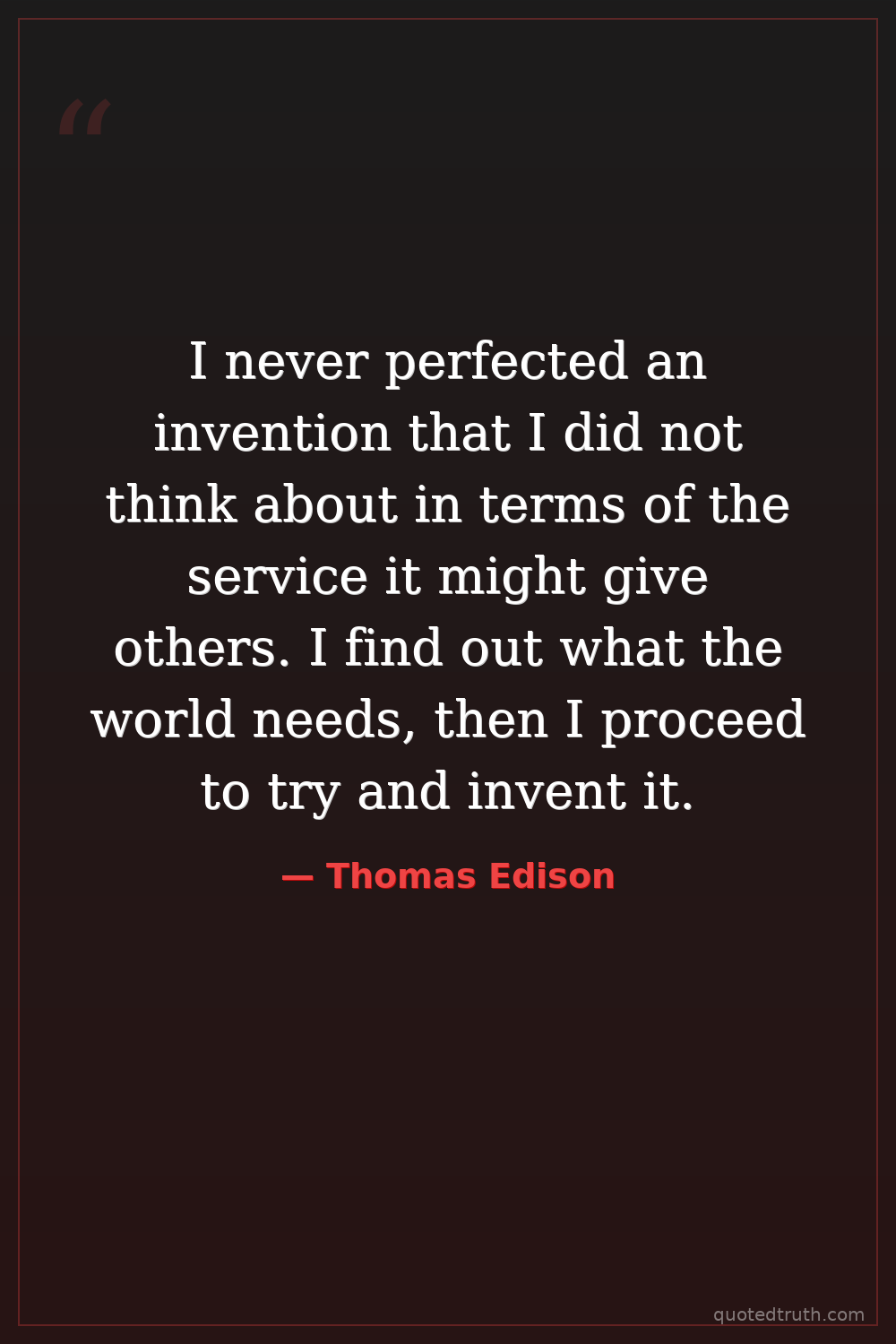
Edison is saying that useful inventions start with real human needs, not with personal cleverness or abstract curiosity. Before building anything, he asks what problem people actually have, then works backward to a solution that serves them. Invention, in his view, is a form of service: if it does not improve someone's daily life, it is not worth perfecting. Market demand and human benefit drive the work, not ego.
Relevance to Thomas Edison
Edison built a career around commercially useful inventions: the practical incandescent bulb, the phonograph, the carbon microphone, and the film camera. He ran Menlo Park as an industrial research lab aimed at marketable products, famously chasing a light bulb people could afford at home. His 1,093 patents cluster around everyday problems—lighting, recorded sound, power distribution—reflecting exactly the needs-first philosophy this quote describes, rather than pure scientific theory.
The era
Edison worked during the late 1800s and early 1900s, when the Second Industrial Revolution was electrifying cities, wiring the telegraph, and pulling Americans from farms into factories and urban homes. Consumers suddenly wanted reliable light, recorded entertainment, and faster communication. Inventors competed fiercely for patents, investors, and public attention, and Edison shaped himself as the commercial 'Wizard of Menlo Park' whose lab translated scientific breakthroughs into products ordinary households could buy and use.
AI-generated insights based on extensive research and information for context. Factual errors? Email [email protected].