Joseph Smith — "I never told you I was perfect; but there is no error in the revelations which I…"
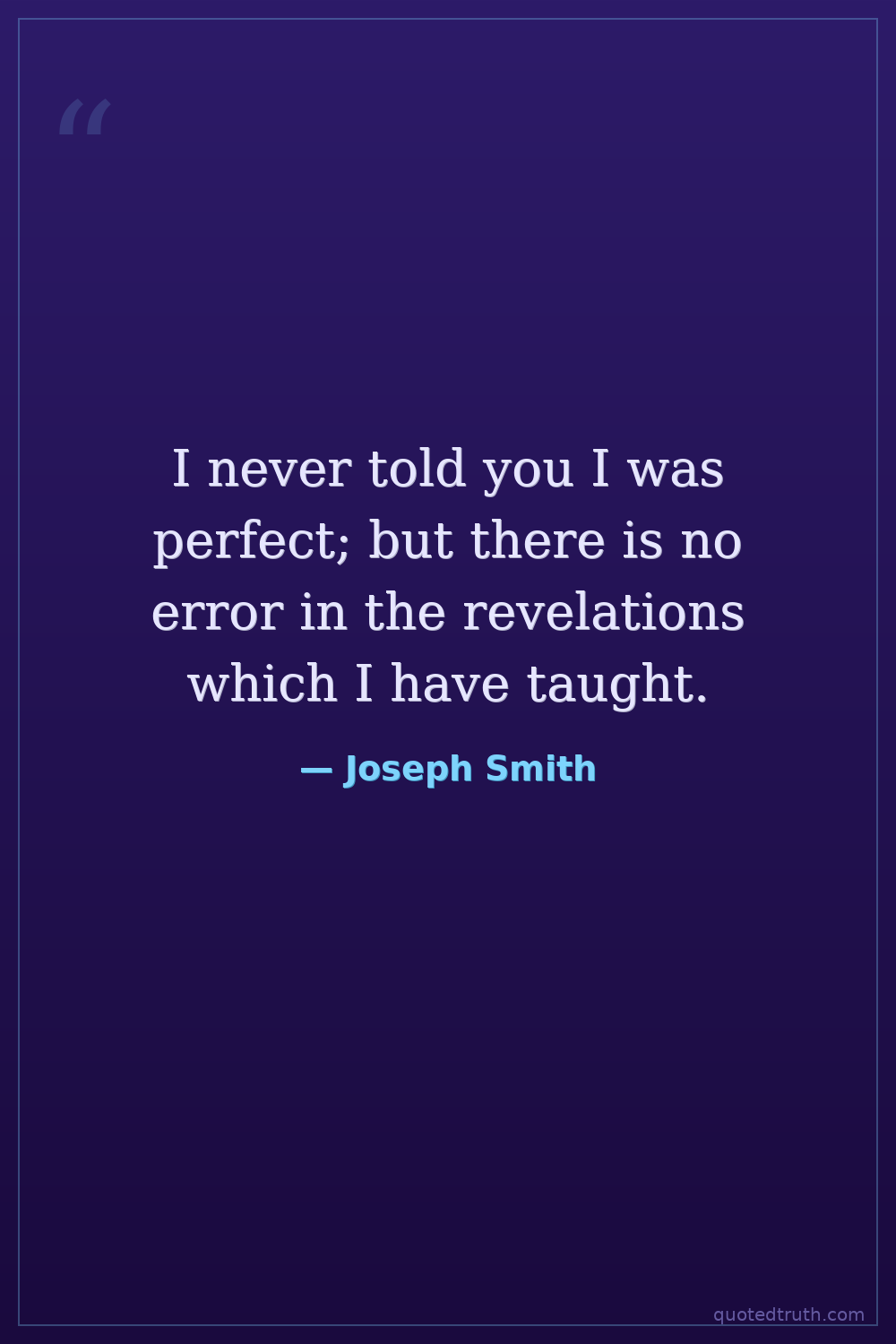
I never told you I was perfect; but there is no error in the revelations which I have taught.
I never told you I was perfect; but there is no error in the revelations which I have taught.
Click any product to generate a realistic preview. Up to 3 at a time.
* Initial load can take up to 90 seconds — revising the preview in another color is nearly instant.
"I am not afraid of death. I have a conscience void of offense toward God and toward all men."
"I have a testimony that the Book of Mormon is true, and I know that God lives."
"I will preach on the one grand key-note of the whole volume of scripture, which is the resurrection of the dead."
"Love is one of the leading characteristics of Deity, and ought to be manifested by those who aspire to be the Sons of God. A man filled with the love of God, is not content with blessing his family al…"
"God will yet reveal many great and important things pertaining to the Kingdom of God."
Found in 1 providers: grok
1 source checked
This quote draws a sharp line between personal imperfection and doctrinal infallibility. Smith concedes he is a flawed human being — fallible in conduct and character — but insists that the revelations he received and taught carry no error because they originate from God, not from himself. It separates the messenger from the message, shielding religious authority from criticism aimed at the man delivering it.
Smith faced relentless scrutiny throughout his life — accusations of treasure-seeking, the Kirtland bank failure, plural marriage he practiced while publicly denying, and multiple legal arrests. Yet he consistently maintained prophetic authority, producing the Book of Mormon, Doctrine and Covenants, and Pearl of Great Price as divine scripture. This quote mirrors his lifelong posture: acknowledging human flaws while insisting his revelatory role remained unblemished, a distinction critical to holding his growing church together.
Smith founded Mormonism during the Second Great Awakening, a period of explosive religious revivalism in early 19th-century America, especially in upstate New York's Burned-Over District. Competing denominations and new prophetic movements proliferated while established churches lost authority. Thousands hungered for direct divine revelation. In this environment, claims of living prophecy were both plausible and polarizing, making Smith's insistence on error-free revelations a powerful recruiting tool and a lightning rod for persecution and mob violence.
AI-generated insights based on extensive research and information for context. Factual errors? Email [email protected].
Your cart is empty