What it means
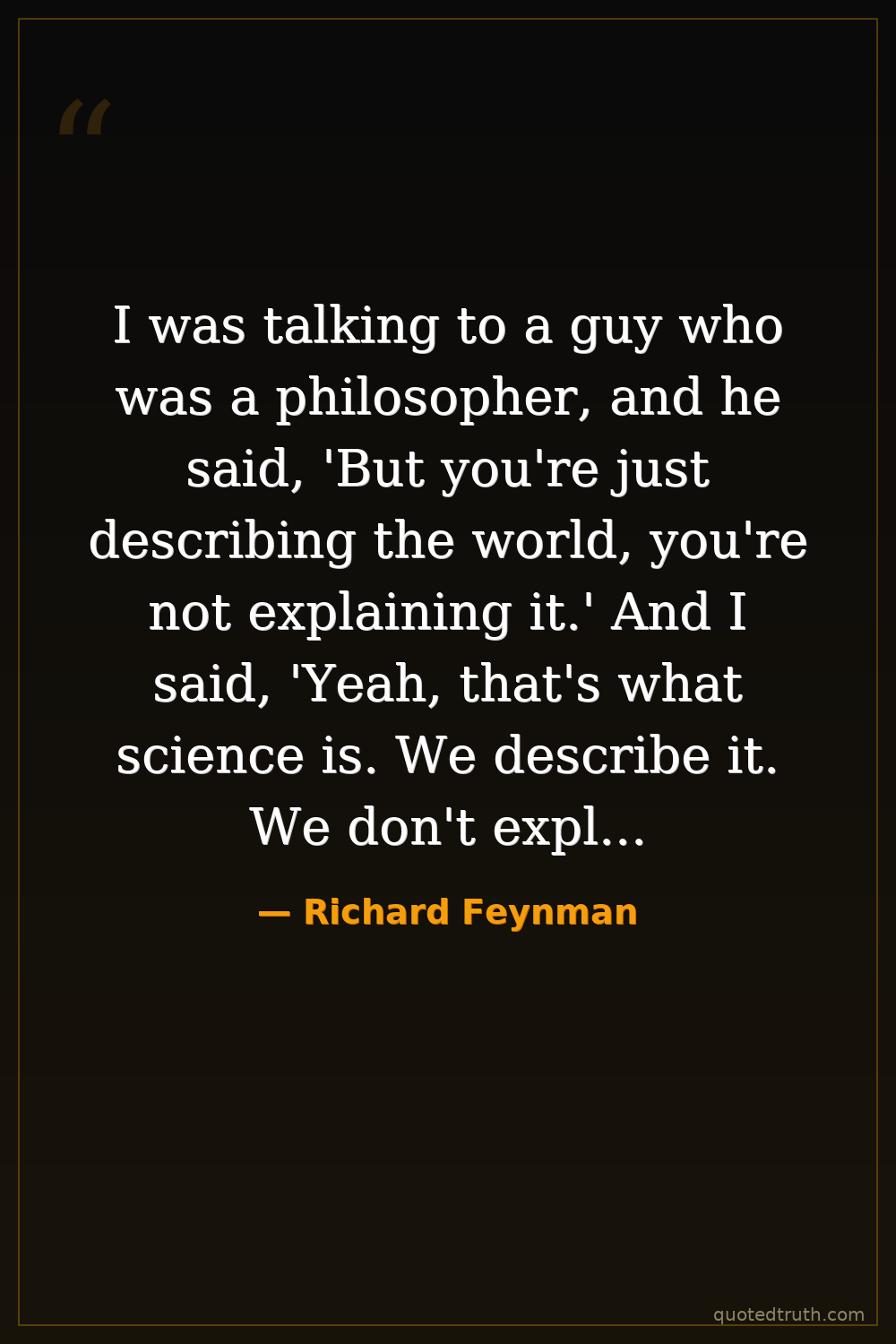
Science builds accurate mathematical models predicting how nature behaves — it doesn't answer the deeper 'why' behind existence. When we say gravity follows an inverse-square law, we're describing a pattern with extraordinary precision, not explaining why gravity exists at all. Feynman argued that science is fundamentally descriptive, and that's not a weakness — rigorous description predicts, tests, and builds technology. Demanding deeper 'explanation' crosses into metaphysics, which science deliberately sidesteps.
Relevance to Richard Feynman
Feynman developed quantum electrodynamics — a theory predicting particle-light interactions to ten decimal places of accuracy — yet notoriously resisted asking what it 'meant' at a deeper level. His famous diagrams are tools for calculating probabilities, not windows onto ultimate reality. He often said knowing a bird's name teaches you nothing about the bird itself. This quote reflects his lifelong insistence that honest, precise description is science's highest achievement, not a consolation prize.
The era
Feynman worked through the mid-20th century's golden age of physics, when quantum mechanics was spectacularly predictive yet philosophically bewildering — nobody agreed on what wave functions 'really' meant. Logical positivism in philosophy was collapsing, leaving live academic debates about scientific realism. Questions like 'does science explain or merely predict?' were unresolved. Feynman's blunt answer — description is enough — was a pragmatist's direct challenge to philosophers demanding more than nature's mathematical patterns.
AI-generated insights based on extensive research and information for context. Factual errors? Email [email protected].