What it means
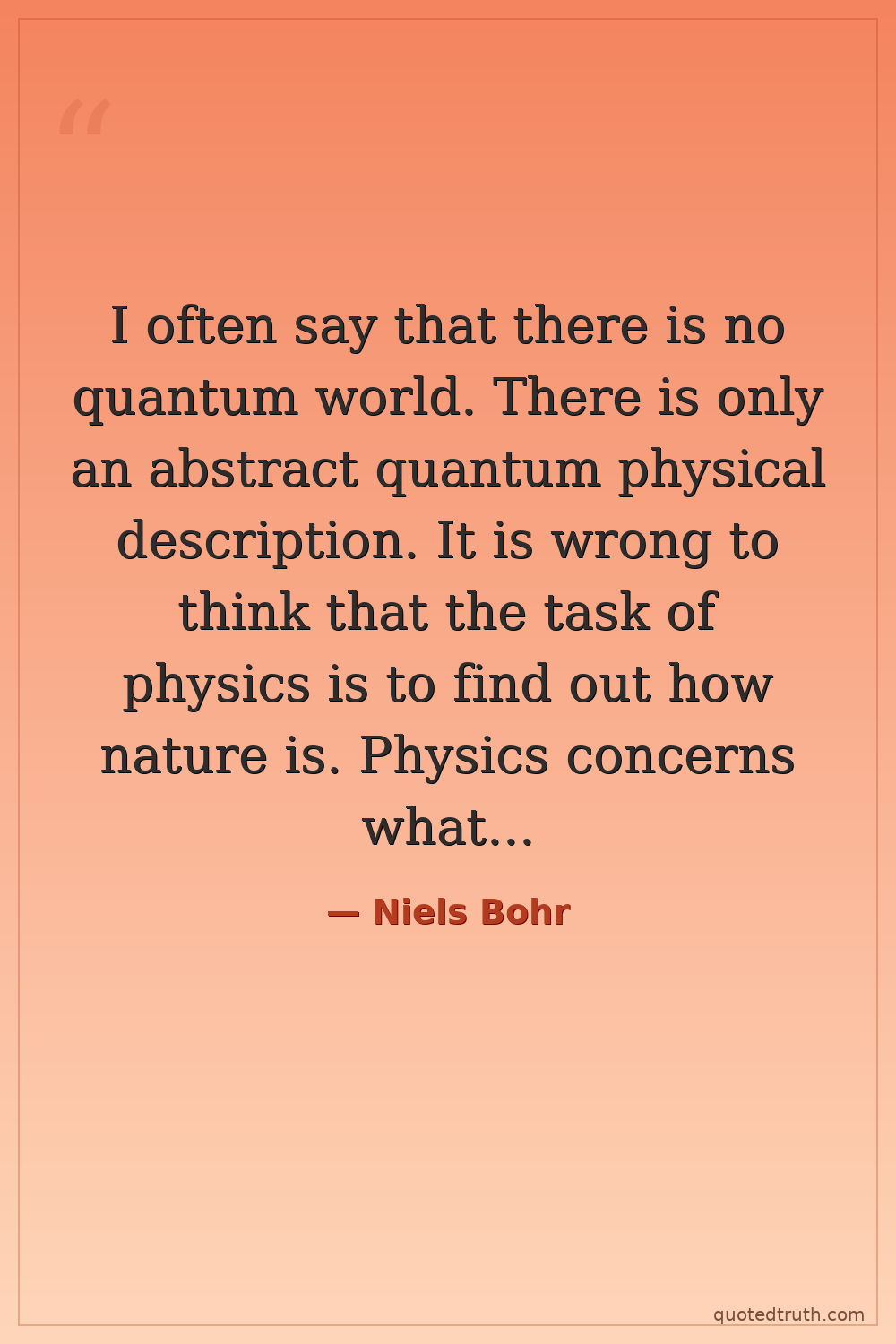
Quantum physics doesn't reveal a hidden reality waiting to be discovered — it gives us a precise language for describing what we observe and measure. Bohr argues physics was never meant to answer 'what is nature really like?' but only 'what can we observe and communicate about nature?' The quantum world isn't a place; it's a framework of descriptions, and confusing the map for the territory leads physics into unanswerable metaphysical traps.
Relevance to Niels Bohr
Bohr co-created the Copenhagen Interpretation, holding that quantum systems have no definite state until observed — the direct philosophical expression of this quote. He spent decades debating Einstein, who insisted physics must describe objective reality independent of observers. Bohr's complementarity principle — that light behaves as wave or particle depending on how you measure it — embodied this stance. As director of Copenhagen's Institute for Theoretical Physics, he made epistemological humility the dominant framework of 20th-century quantum physics.
The era
The 1920s–1930s shattered classical physics' assumption that nature has definite, observer-independent properties. Heisenberg's uncertainty principle, wave-particle duality, and the 1935 Einstein-Podolsky-Rosen paradox forced physicists to confront what their equations actually meant. Einstein insisted on hidden variables and objective reality; Bohr's camp said that question was unanswerable. After Hiroshima demonstrated physics' destructive power, separating physical description from claims about ultimate reality became not just intellectually but ethically urgent — science as language, not gospel.
AI-generated insights based on extensive research and information for context. Factual errors? Email [email protected].