What it means
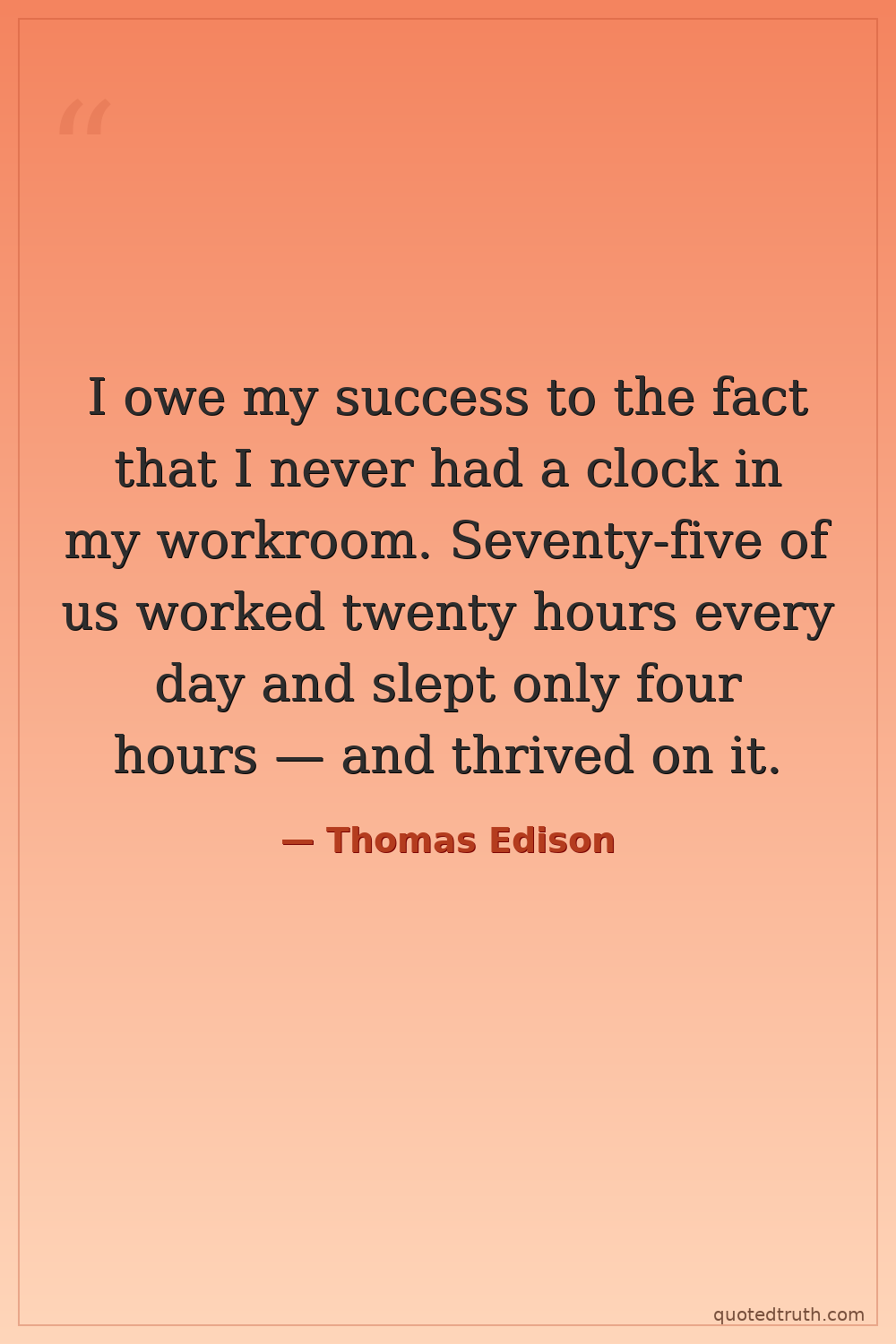
Edison claims his achievements came from refusing to track time while working. He and seventy-five collaborators pushed twenty-hour shifts with only four hours of sleep, and insists they flourished under that punishing schedule. The point is that obsessive, clock-free immersion in a problem — not balanced hours — produced breakthroughs. Ignore the workday, chase the work itself, and treat exhaustion as fuel rather than a warning sign worth heeding.
Relevance to Thomas Edison
Edison ran Menlo Park and later West Orange as round-the-clock invention factories, famously napping on lab benches between experiments on the light bulb, phonograph, and motion picture camera. He held 1,093 US patents and openly dismissed sleep as wasteful. The 'seventy-five' are his muckers — the team of machinists, chemists, and engineers he drove relentlessly. The quote captures his real management style, which produced breakthroughs but also burned out assistants like Tesla.
The era
Edison worked through the late 1800s Gilded Age, when industrial America glorified grueling hours, twelve-hour factory shifts were standard, and labor protections barely existed. Electric lighting itself was erasing the natural workday, letting laboratories and factories run past sundown for the first time. Inventors competed ferociously in patent races against Westinghouse, Bell, and Tesla, and the cultural ideal of the self-made industrialist rewarded visible sacrifice. Unions pushing the eight-hour day were still fighting an uphill battle.
AI-generated insights based on extensive research and information for context. Factual errors? Email [email protected].