What it means
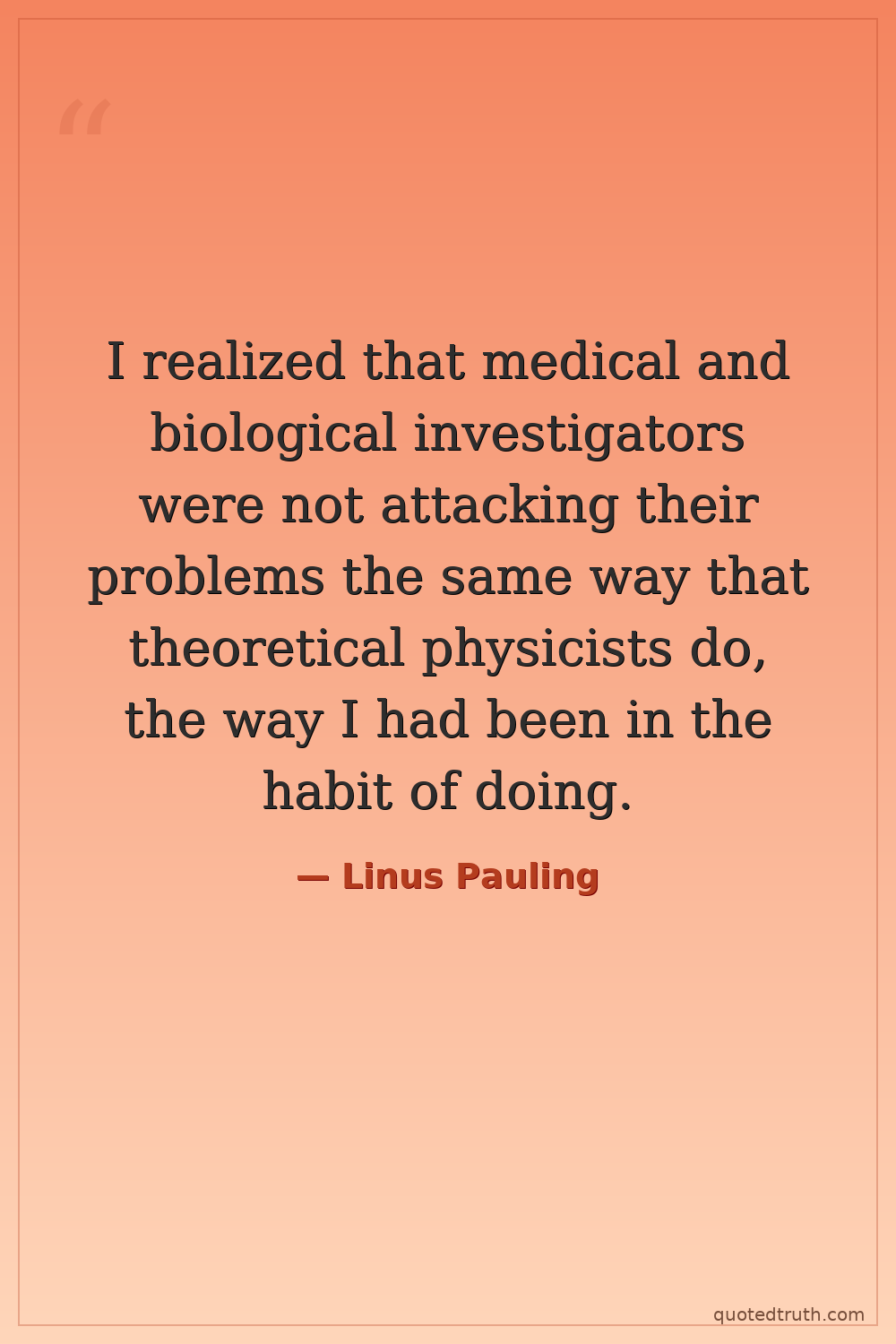
Pauling observed that biomedical researchers relied on empirical observation and clinical evidence, while theoretical physicists — his native discipline — built abstract frameworks and models first, then tested them against reality. He saw biology and medicine as problem-solving cultures oriented toward data collection rather than theory construction. The quote captures his surprise at this methodological divide and his conviction that importing physics-style reasoning could accelerate medical discovery.
Relevance to Linus Pauling
Pauling won two Nobel Prizes — Chemistry (1954) for chemical bond theory, Peace (1962) — spending his career applying physicist-style quantitative reasoning to molecular biology, discovering protein alpha-helix structures and nearly solving DNA before Watson and Crick. Later he championed orthomolecular medicine, prescribing large vitamin C doses based on theoretical chemistry rather than clinical trials — a direct expression of this physicist's mindset applied to medicine, for better and worse.
The era
In the mid-20th century, physics was remaking biology: X-ray crystallography, quantum mechanics, and information theory were revolutionizing how scientists understood life. Pauling's 1930s–1950s peak career coincided with the molecular biology revolution, when reductionist, mathematical thinking began displacing purely observational medicine. Medicine remained largely empirical and trial-based while physics operated through grand unifying theories — creating a real cultural and methodological gap between disciplines that Pauling uniquely straddled and sought to close.
AI-generated insights based on extensive research and information for context. Factual errors? Email [email protected].