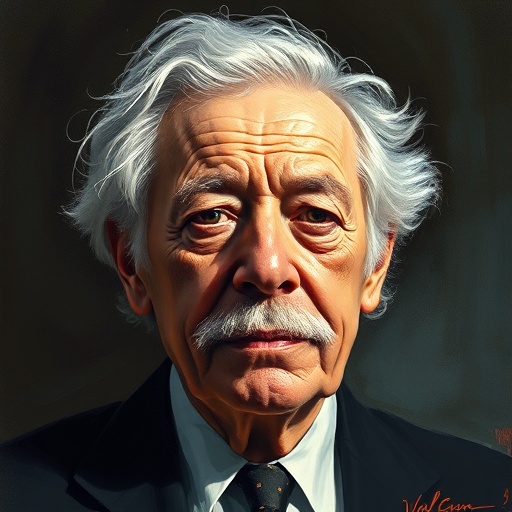
Linus Pauling — "Science is the search for truth -- it is not a game in which one tries to beat h…"
Science is the search for truth -- it is not a game in which one tries to beat his opponent, to do harm to others.
Science is the search for truth -- it is not a game in which one tries to beat his opponent, to do harm to others.
Click any product to generate a realistic preview. Up to 3 at a time.
* Initial load can take up to 90 seconds — revising the preview in another color is nearly instant.
"The only way to get a good idea is to get a lot of ideas and throw the bad ones away."
"Never put your trust into anything but your own intellect. Your elder, no matter whether he has gray hair or has lost his hair, no matter whether he is a Nobel laureate — may be wrong. The world progr…"
"Every man of science has some favorite hypothesis which he cultivates, and with which he is so intimately bound up, that he would be glad to see it universally adopted."
"I am convinced that there is no disease that cannot be cured by a proper intake of vitamin C."
"I have spent a good deal of my life trying to get people to eat more vitamin C."
Found in 1 providers: gemini
1 source checked
Science exists to uncover what is real—nothing more. Pauling draws a sharp line between honest inquiry and competitive combat. When researchers treat their work as a battle to win rather than a truth to find, they corrupt science's purpose. Knowledge gained through rivalry, deception, or a drive to outmaneuver others isn't science—it's politics or warfare in a lab coat. The goal must always be understanding, never victory over an opponent.
Pauling won Nobel Prizes in both Chemistry (1954) and Peace (1962)—the only person to win two unshared Nobels. He watched his molecular research feed weapons programs during World War II and the Cold War. His public campaign against nuclear testing, co-founding of the Pugwash movement, and refusal to sign loyalty oaths all reflected a scientist who believed truth-seeking and protecting human life were inseparable obligations, not competing priorities.
Pauling spoke during the Cold War, when the U.S. and Soviet Union turned science into an arms race—nuclear physics producing bombs capable of ending civilization. The Manhattan Project proved scientific discovery could be weaponized at industrial scale. McCarthyism branded peace-minded scientists as subversives. Sputnik in 1957 reframed research as national competition. Against this backdrop, insisting science must serve truth rather than political dominance or military advantage was both radical and urgent.
AI-generated insights based on extensive research and information for context. Factual errors? Email [email protected].
Your cart is empty