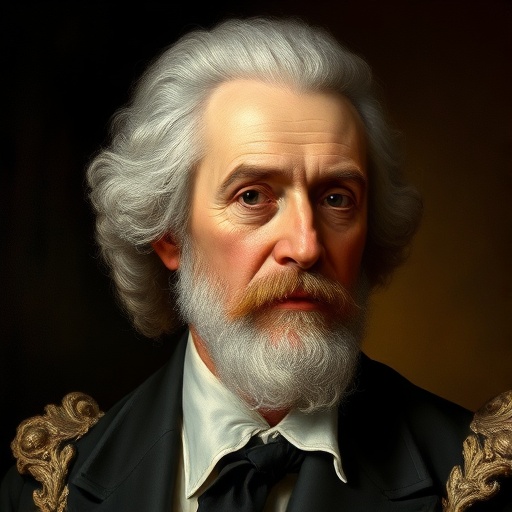
Antoine Lavoisier — "I shall be happy if my work contributes to the progress of the sciences, and to …"
I shall be happy if my work contributes to the progress of the sciences, and to the well-being of mankind.
I shall be happy if my work contributes to the progress of the sciences, and to the well-being of mankind.
Click any product to generate a realistic preview. Up to 3 at a time.
* Initial load can take up to 90 seconds — revising the preview in another color is nearly instant.
"The more exact the science, the more difficult it is to make progress."
"The true philosopher is he who knows how to doubt."
"We must trust to nothing but facts: these are presented to us by nature and cannot deceive."
"It is not often that a man has the opportunity to be useful to his fellow citizens without any personal risk."
"It is not enough to observe; one must make experiments."
Found in 1 providers: grok
1 source checked
The speaker finds genuine fulfillment not in personal glory or wealth, but in advancing human knowledge and improving people's lives. Science is framed as a moral act — its worth measured by what it gives to society. This is a statement about purpose: that meaningful work serves something larger than oneself, and that contributing to collective progress is its own reward.
Lavoisier transformed chemistry from alchemy into rigorous science, naming oxygen, disproving phlogiston theory, and establishing conservation of mass. He simultaneously served as a tax collector and public administrator, funding his laboratory privately. His work on gunpowder improved French national defense. His statement reflects a man who genuinely bridged scientific discovery and practical human benefit throughout his career.
Lavoisier worked during the Enlightenment, when European thinkers believed reason and science could liberate humanity from superstition, disease, and poverty. The French Revolution erupted during his lifetime, demanding that institutions serve the people. The idea that scientific progress had a civic duty — not just intellectual value — was central to Enlightenment thought, making Lavoisier's sentiment both philosophically resonant and politically charged for his era.
AI-generated insights based on extensive research and information for context. Factual errors? Email [email protected].
Your cart is empty