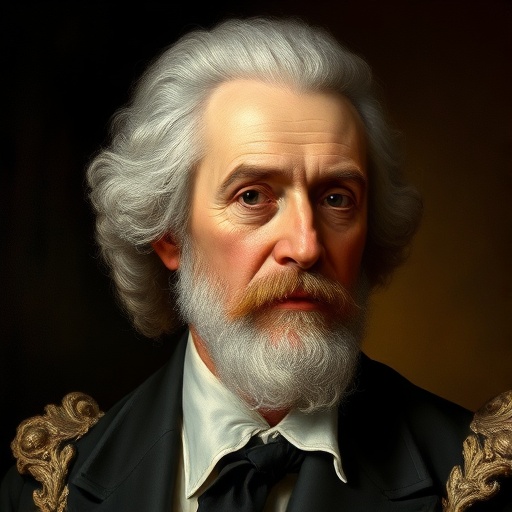
Antoine Lavoisier — "The more exact the science, the more difficult it is to make progress."
The more exact the science, the more difficult it is to make progress.
The more exact the science, the more difficult it is to make progress.
Click any product to generate a realistic preview. Up to 3 at a time.
* Initial load can take up to 90 seconds — revising the preview in another color is nearly instant.
"The art of drawing conclusions from experiments and observations consists in evaluating probabilities and in judging if they are great enough to constitute proofs."
"The human mind is capable of understanding all the secrets of nature."
"The greatest obstacle to discovery is not ignorance, but the illusion of knowledge."
"I have lived long enough to be certain that the world will not be ready for my discoveries until at least a hundred years after my death."
"It took them only an instant to cut off that head, but France may not produce another like it in a century."
Found in 1 providers: grok
1 source checked
As a scientific field grows more rigorous—dependent on precise measurement, repeatable experiments, and strict standards—the threshold for genuine progress rises sharply. Vague disciplines can claim advances with loose observations; exact sciences demand every new finding survive quantitative scrutiny. Each forward step requires a higher burden of proof, making real discoveries rarer and harder to achieve than in fields where imprecision still passes for insight.
Lavoisier transformed chemistry into an exact science through meticulous measurement—his careful weighing experiments disproved phlogiston theory and established conservation of mass. He understood firsthand that once chemistry demanded quantitative rigor, clever arguments no longer counted as progress. Every claim required reproducible data. His decades-long struggle to systematize elements, redefine combustion, and establish rational nomenclature showed that exactness raises the bar for what constitutes genuine scientific advancement.
The late 18th-century Enlightenment saw natural philosophy shifting from qualitative speculation to quantitative rigor. Chemistry was particularly chaotic—phlogiston theory dominated, terminology was inconsistent, and few experiments used controlled measurement. As Lavoisier imposed precision—standardized units, careful balances, systematic nomenclature—earlier discoveries were exposed as errors. The harder standard meant advancing chemistry now required defeating well-established but wrong theories with irrefutable experimental data, making each breakthrough genuinely costly to earn.
AI-generated insights based on extensive research and information for context. Factual errors? Email [email protected].
Your cart is empty