What it means
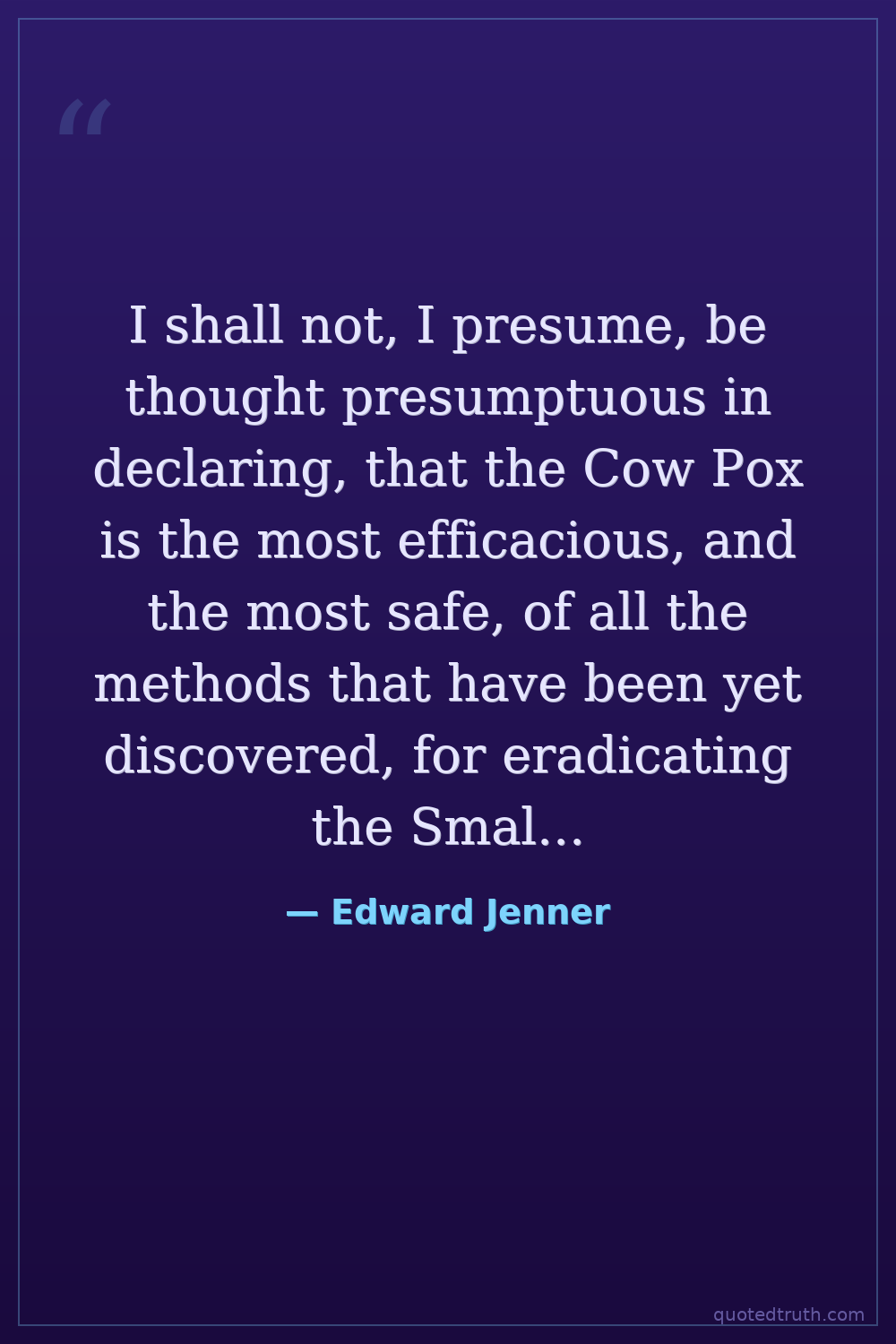
Jenner asserts, with deliberate but hedged confidence, that cowpox inoculation is the most effective and safest method ever found to eliminate smallpox. The double use of 'presume/presumptuous' signals awareness that this is a bold claim — yet he stands firmly behind it. Crucially, he says 'eradicating,' not merely treating: he envisions complete elimination of a disease, a concept so radical it set the template for all future vaccination science.
Relevance to Edward Jenner
Jenner spent years observing that milkmaids who contracted cowpox rarely developed smallpox, then tested his theory in 1796 by inoculating eight-year-old James Phipps with cowpox material. His 1798 publication faced fierce resistance from physicians invested in variolation. This quote captures his core character: a quietly persistent empiricist willing to stake his reputation on observable evidence over establishment orthodoxy, confident enough to declare not just a treatment but a path to total eradication.
The era
In the late 18th century, smallpox killed an estimated 400,000 Europeans annually and disfigured millions more. Variolation — deliberate inoculation with live smallpox material — had been practiced since 1721 but carried a real mortality risk of roughly one in fifty. The Enlightenment's faith in empirical science was reshaping medicine, yet disease eradication remained an unthinkable concept. Jenner's declaration that a disease could be fully eliminated was among the most radical public health statements ever made.
AI-generated insights based on extensive research and information for context. Factual errors? Email [email protected].