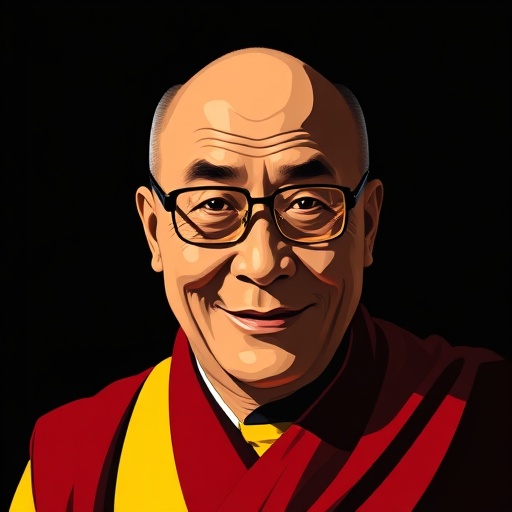
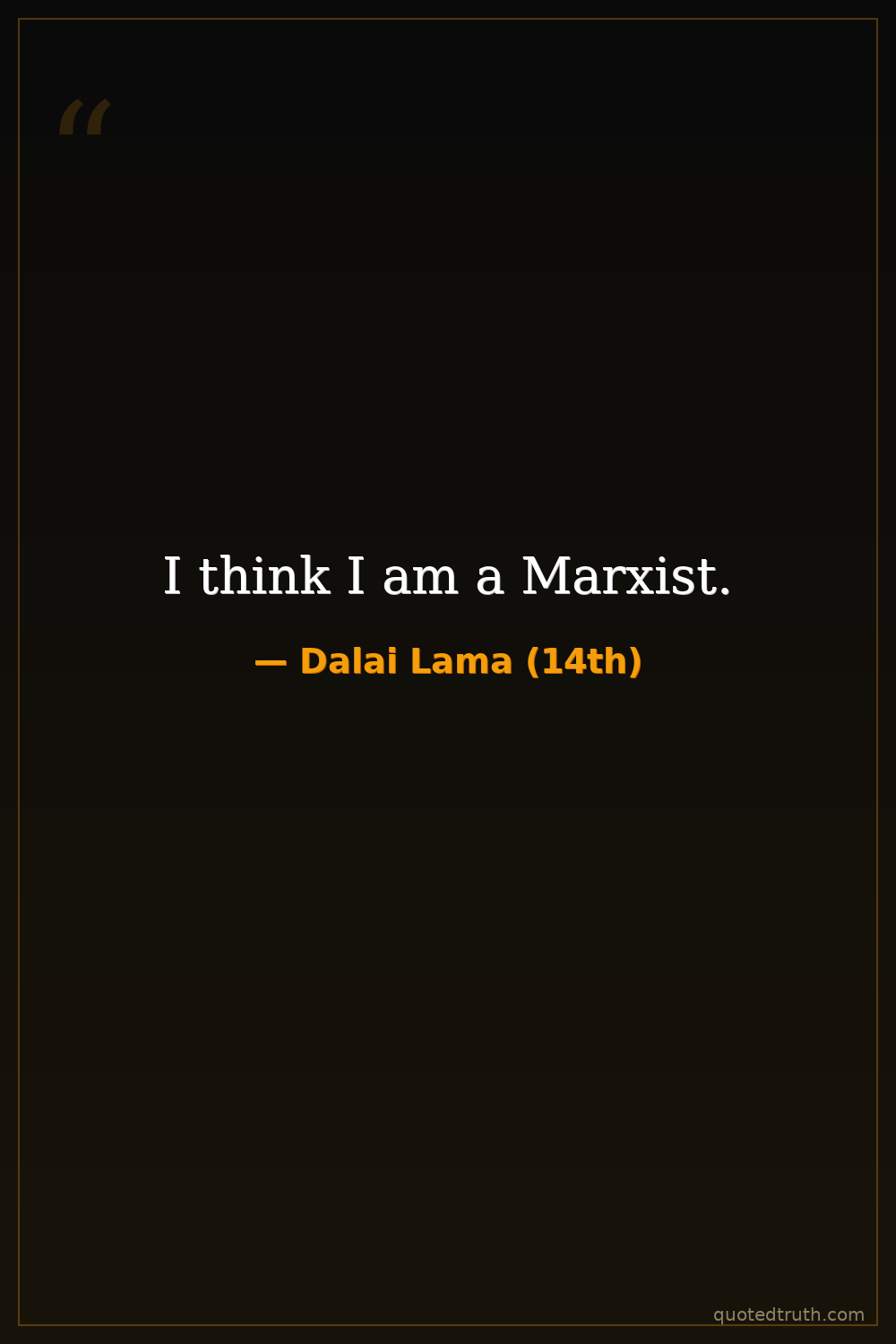
Dalai Lama (14th) — "I think I am a Marxist."
I think I am a Marxist.
I think I am a Marxist.
Click any product to generate a realistic preview. Up to 3 at a time.
* Initial load can take up to 90 seconds — revising the preview in another color is nearly instant.
"Dialogue is the only way to resolve differences."
"Europe, I think, Europe is for Europeans."
"The ultimate authority must always rest with the individual's own reason and critical analysis."
"Compassion is the radicalism of our time."
"We need to understand that inner peace is the key to world peace."
Found in 1 providers: grok
1 source checked
The quote expresses alignment with Marxist economic ideals — concern for the poor, critique of capitalist exploitation, and support for wealth redistribution. The Dalai Lama has clarified he admires Marx's focus on economic equality but rejects atheism and authoritarian communism. It signals that caring for the economically marginalized is a moral priority. He separates Marxist ethics from how communist governments actually implemented those ideas, which he views as corrupt distortions.
Tenzin Gyatso, born 1935, fled Tibet in 1959 after China's communist government violently suppressed Tibetan autonomy — making this statement doubly striking. Living in exile in Dharamsala, India, he has spent decades advocating for the marginalized. His Buddhist principle of karuna (compassion) drives his alignment with Marxist concern for workers and the poor. He explicitly praises Marx's economic critique while rejecting Soviet and Chinese authoritarian implementations that caused immense suffering.
In the contemporary era, global wealth inequality widened dramatically under neoliberal capitalism, especially after the 2008 financial crisis exposed systemic failures. The Cold War's end discredited state communism but did not eliminate economic injustice. The Dalai Lama made this statement repeatedly from the 1990s onward, challenging the assumption that capitalism is morally neutral. It resonates amid growing movements against inequality, from Occupy Wall Street to debates about universal basic income and wealth taxes.
AI-generated insights based on extensive research and information for context. Factual errors? Email [email protected].
Your cart is empty