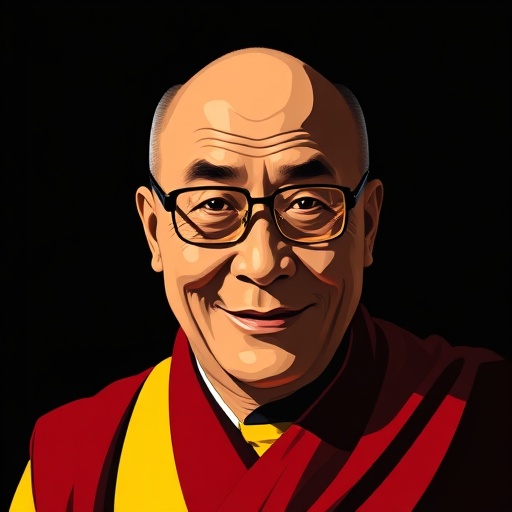
Dalai Lama (14th) — "We need to understand that inner peace is the key to world peace."
We need to understand that inner peace is the key to world peace.
We need to understand that inner peace is the key to world peace.
Click any product to generate a realistic preview. Up to 3 at a time.
* Initial load can take up to 90 seconds — revising the preview in another color is nearly instant.
"I consider myself a simple Buddhist monk. Nothing more, nothing less."
"I hope that my life will be of benefit to all sentient beings."
"If scientific analysis were conclusively to demonstrate certain claims in Buddhism to be false, then we must accept the findings of science and abandon those claims."
"When we meet real tragedy in life, we can react in two ways — either by losing hope and falling into self-destructive habits, or by using the challenge to find our inner strength."
"In the practice of tolerance, one’s enemy is the best teacher."
Found in 1 providers: grok
1 source checked
External conflict—war, violence, social breakdown—originates inside individuals. When people cultivate patience, compassion, and emotional stability within themselves, they stop projecting fear, anger, and hatred outward onto others. Collective peace cannot be built by treaties or force alone; it emerges when enough individuals transform their inner states. Personal psychological harmony is therefore a prerequisite for peaceful societies, not a byproduct of them.
Tenzin Gyatso has lived this principle under extreme pressure: exiled from Tibet in 1959 after China's military crackdown, he spent six decades advocating nonviolence without personal bitterness toward Beijing. His Buddhist practice centers on transforming anger into compassion through meditation and discipline. Awarded the Nobel Peace Prize in 1989, his entire public life demonstrates that responding to oppression with equanimity rather than hatred is both personally sustainable and geopolitically meaningful.
Born in 1935 and leading through the Cold War, nuclear arms race, Tibet's occupation, Vietnam War, Tiananmen Square, and post-9/11 global terrorism, the Dalai Lama addressed a world where military deterrence dominated statecraft. Materialism and ideological rivalry defined international relations. His message directly challenged the prevailing assumption that security flows from superior force, positioning individual inner transformation as the foundational geopolitical act during decades of escalating state-sponsored and ideological violence.
AI-generated insights based on extensive research and information for context. Factual errors? Email [email protected].
Your cart is empty