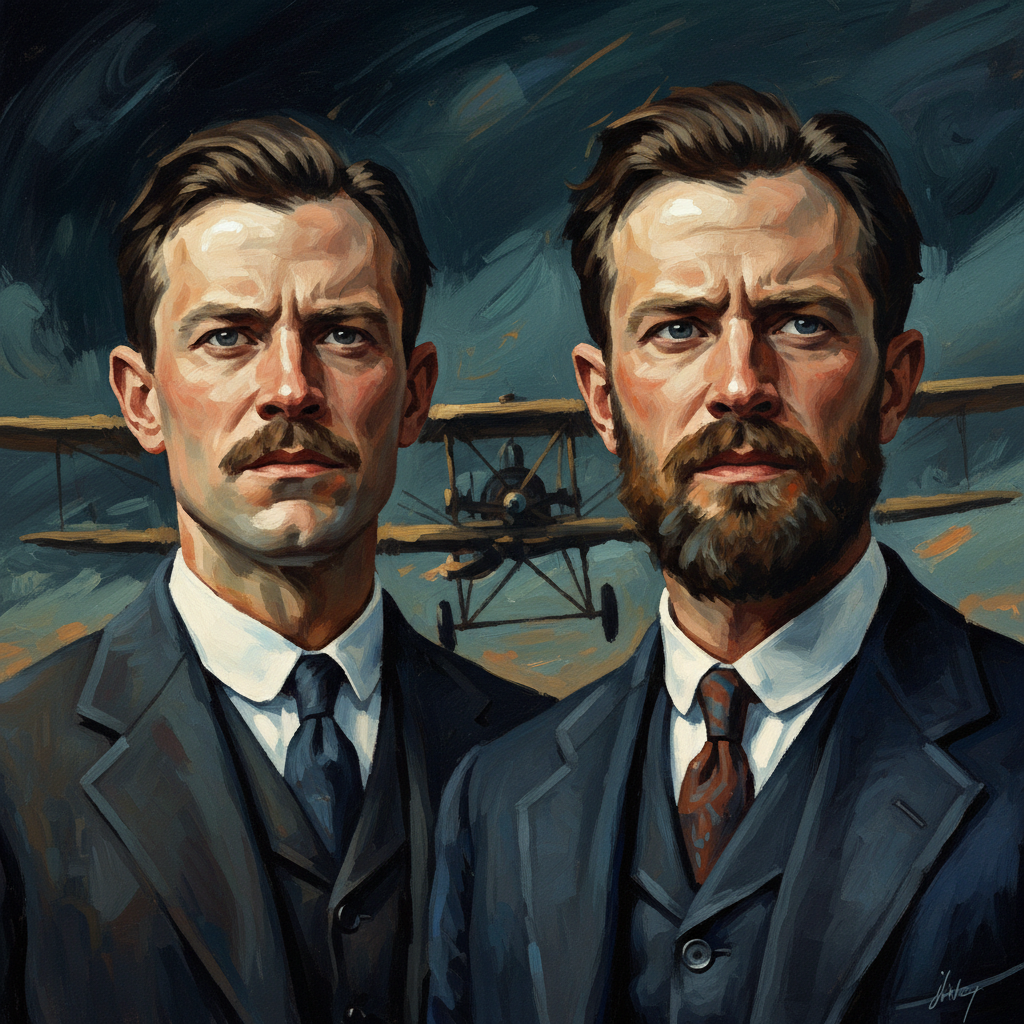
Wright Brothers (Orville & Wilbur) — "I think it will be a long time yet before anyone will be flying at any great hei…"
I think it will be a long time yet before anyone will be flying at any great height or speed.
I think it will be a long time yet before anyone will be flying at any great height or speed.
Click any product to generate a realistic preview. Up to 3 at a time.
* Initial load can take up to 90 seconds — revising the preview in another color is nearly instant.
"We have not yet fully solved the problem of balance in high winds."
"We do not believe that the difficulties are insurmountable, and we are confident that we shall yet succeed."
"We had no idea of the amount of publicity that would follow our flights."
"We were not looking for a fortune, but we were looking for a solution."
"We do not intend to fly for money, but for the love of the art."
American aviation pioneers who achieved the first sustained powered controlled airplane flight at Kitty Hawk, NC, on December 17, 1903. Closely associated with Octave Chanute (their gliding mentor and aeronautical correspondent). For an intellectual contrast, see Samuel Pierpont Langley, Smithsonian Institution Secretary and government-funded aviation researcher — Langley's Aerodrome crashed twice into the Potomac in October-December 1903 with $50,000 of War Department funding; the Wright Brothers' bicycle-shop empiricism beat Langley's institutional Big Science by 9 days. The most-cited example in engineering history of empirical-tinkerer beating institution-funded credentialism.
Found in 1 providers: grok
1 source checked
The speaker predicts that significant advances in altitude and velocity of flight are still far off. Even though basic powered flight has been achieved, pushing aircraft to climb high into the sky or move at remarkable speeds will require many more years of development. The statement is a cautious forecast, tempering excitement about early aviation with a realistic sense of how slowly the technology will mature toward ambitious performance goals.
The Wrights were bicycle mechanics turned aeronautical engineers who achieved the first controlled powered flight in 1903 at Kitty Hawk. Their initial hops covered only a few hundred feet at low altitude and modest speeds. Having wrestled firsthand with wing warping, underpowered engines, and fragile airframes, they understood the engineering limits better than anyone. This remark reflects their characteristic engineering humility and methodical caution, a trait that contrasted sharply with bolder promoters who overpromised aviation's immediate potential.
In the early 1900s, aviation was an infant field greeted with skepticism; many scientists had recently declared heavier-than-air flight impossible. Aircraft were wooden, cloth-covered, and powered by weak internal combustion engines. No infrastructure, instruments, or aerodynamic theory existed for high-altitude or high-speed travel. Railroads and ocean liners still dominated long-distance transport. The Wrights spoke during a moment when even staying airborne for a minute was astonishing, making predictions of altitude and speed seem genuinely distant.
AI-generated insights based on extensive research and information for context. Factual errors? Email [email protected].
Your cart is empty