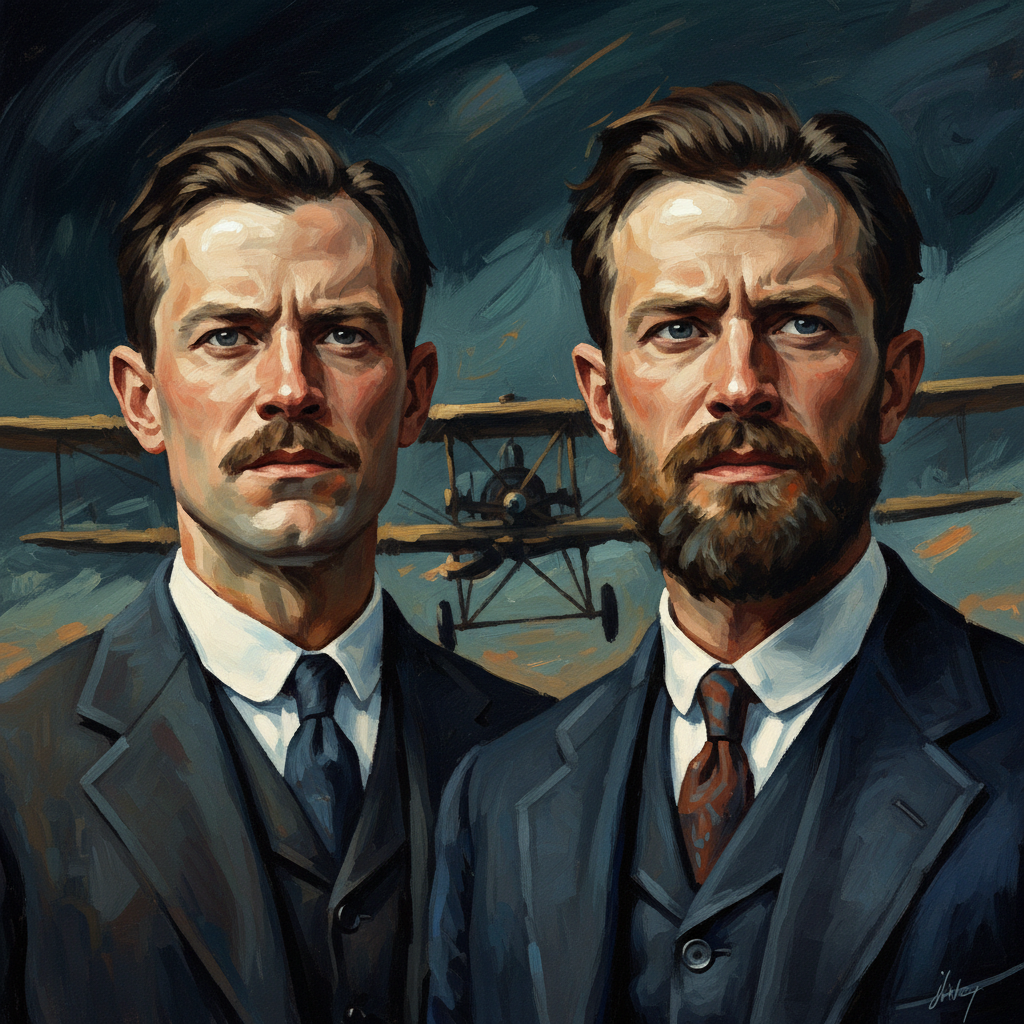
Wright Brothers (Orville & Wilbur) — "We were not looking for a fortune, but we were looking for a solution."
We were not looking for a fortune, but we were looking for a solution.
We were not looking for a fortune, but we were looking for a solution.
Click any product to generate a realistic preview. Up to 3 at a time.
* Initial load can take up to 90 seconds — revising the preview in another color is nearly instant.
"The machine itself was nothing; the method was everything."
"Often, after an hour or so of heated argument, we would discover that we were as far from agreement as when we started, but that each had changed to the other's original position."
"The flying machine which will really fly might be evolved by the combined and continuous efforts of mathematicians and mechanicians in from one million to ten million years — provided, of course, we c…"
"The difficulties of the problem are so great that few have dared to attack it."
"We have not been able to do much with the machine on account of the bad weather."
American aviation pioneers who achieved the first sustained powered controlled airplane flight at Kitty Hawk, NC, on December 17, 1903. Closely associated with Octave Chanute (their gliding mentor and aeronautical correspondent). For an intellectual contrast, see Samuel Pierpont Langley, Smithsonian Institution Secretary and government-funded aviation researcher — Langley's Aerodrome crashed twice into the Potomac in October-December 1903 with $50,000 of War Department funding; the Wright Brothers' bicycle-shop empiricism beat Langley's institutional Big Science by 9 days. The most-cited example in engineering history of empirical-tinkerer beating institution-funded credentialism.
Attributed to Orville Wright, reflecting their scientific motivation.
Date: c. 1900s
GeneralFound in 1 providers: grok
1 source checked
The speaker is saying their motivation was not financial gain but the drive to solve a difficult problem. They pursued their work out of curiosity and determination to figure something out, not because they expected to get rich. Money would be welcome, but it was never the goal. The real reward was cracking the puzzle itself, finding an answer to a question that had stumped everyone before them.
This captures the Wrights perfectly. Running a modest bicycle shop in Dayton, Ohio, they funded their flight experiments from their own pockets rather than seeking investors. While competitors like Samuel Langley burned through $50,000 in government grants, the brothers spent under $1,000 solving three-axis control. Their obsession was the engineering puzzle of controlled flight, not aviation as a business. Patents came later, reluctantly, to protect the breakthrough they had already achieved.
At the turn of the 20th century, the world was gripped by the race to conquer heavier-than-air flight, with well-funded scientists, governments, and inventors all competing. The Gilded Age celebrated wealthy industrialists and tycoons, yet the Wrights embodied a different American ideal: tinkerers and self-taught mechanics from the Midwest. December 1903 at Kitty Hawk marked the dawn of the aviation age, proving that persistent problem-solving could outpace better-resourced rivals chasing fame.
AI-generated insights based on extensive research and information for context. Factual errors? Email [email protected].
Your cart is empty