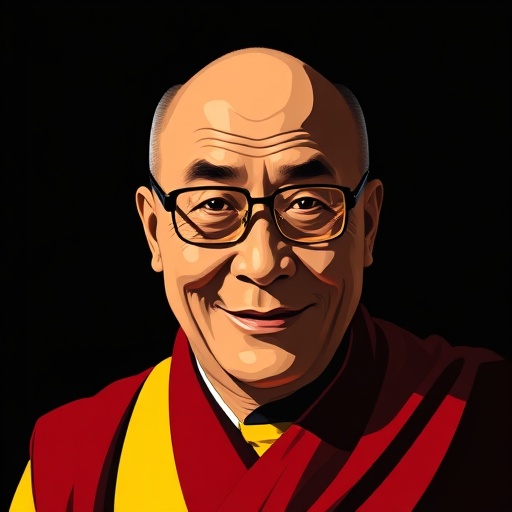
Dalai Lama (14th) — "I think of myself as a human being first, and then as a Buddhist monk."
I think of myself as a human being first, and then as a Buddhist monk.
I think of myself as a human being first, and then as a Buddhist monk.
Click any product to generate a realistic preview. Up to 3 at a time.
* Initial load can take up to 90 seconds — revising the preview in another color is nearly instant.
"Silence is sometimes the best answer."
"I am just a human being, a simple Buddhist monk."
"I joke sometimes that I am the longest-serving refugee."
"Sometimes I joke that if I come back as a woman, I want to be a beautiful woman."
"I think the modern world is too much focused on material things. We need to focus more on spiritual values."
Found in 1 providers: grok
1 source checked
Shared humanity outranks any religious label or institutional role. Before doctrine, title, or sectarian identity, the speaker claims membership in the human family as their primary allegiance. It's a statement about universal common ground — compassion, suffering, and dignity connect all people regardless of faith. Religious identity is real but secondary to what every person already shares simply by existing. This positions kindness and mutual recognition as more foundational than any specific tradition.
Tenzin Gyatso has built his public life around this principle. Exiled from Tibet since 1959, he has engaged with scientists, atheists, and people of every faith — not as a Buddhist recruiting others, but as a fellow human seeking shared ethics. His book Beyond Religion (2011) explicitly argues for secular ethics independent of any faith. He famously says his religion is kindness, treating compassion as a human quality, not a Buddhist one.
The contemporary era has seen religious identity weaponized — the 9/11 aftermath, sectarian wars in Iraq, Hindu nationalism, Christian nationalism, and ethnic cleansing framed as holy cause. In this climate of religious polarization, asserting shared humanity over tribal faith identity carries real weight. The Dalai Lama also navigates China's efforts to delegitimize him as a political separatist hiding behind religion, making this distinction both personally meaningful and politically strategic.
AI-generated insights based on extensive research and information for context. Factual errors? Email [email protected].
Your cart is empty