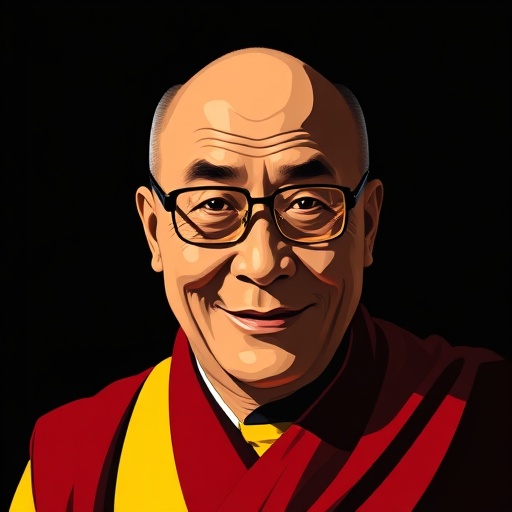
Dalai Lama (14th) — "I think the most important thing is to be a good human being. That is the essenc…"
I think the most important thing is to be a good human being. That is the essence of all religions.
I think the most important thing is to be a good human being. That is the essence of all religions.
Click any product to generate a realistic preview. Up to 3 at a time.
* Initial load can take up to 90 seconds — revising the preview in another color is nearly instant.
"The planet does not need more successful people. The planet desperately needs more peacemakers, healers, restorers, storytellers, and lovers of all kinds."
"I think the best way to solve problems is through dialogue and negotiation. Violence is never the answer."
"It is under the greatest adversity that there is the greatest potential for doing good, both for oneself and others."
"I don't think I am special. I am just a human being, like everyone else."
"I have been asked, 'What is the true meaning of life?' I replied, 'To be happy and useful.'"
Found in 1 providers: grok
1 source checked
This quote cuts straight to religion's ethical core: above doctrine, ritual, or creed, what matters most is simply being a good person. It argues all faiths — regardless of theology — share the same fundamental goal: cultivating compassion, honesty, and care for others. Religious labels and institutional differences matter far less than the quality of your character and how you treat people daily.
Tenzin Gyatso has lived this belief across six decades of exile from Tibet. His concept of 'secular ethics' — developed in works like Beyond Religion — argues moral conduct doesn't require religious faith. He has engaged leaders of Christianity, Islam, Judaism, and Hinduism in sustained interfaith dialogue, consistently centering shared compassion over doctrinal rivalry. Winning the Nobel Peace Prize in 1989 validated his universalist approach on the world stage.
The contemporary era has been defined by religious conflict: Cold War ideological battles, post-9/11 sectarian violence, Hindu-Muslim tensions in South Asia, and the Israeli-Palestinian struggle. Rising secularism simultaneously challenged religion's role in public life. Against this backdrop, a globally recognized Buddhist leader arguing for universal human decency — transcending specific faiths — offered a desperately needed framework for coexistence in an increasingly fractured and polarized world.
AI-generated insights based on extensive research and information for context. Factual errors? Email [email protected].
Your cart is empty