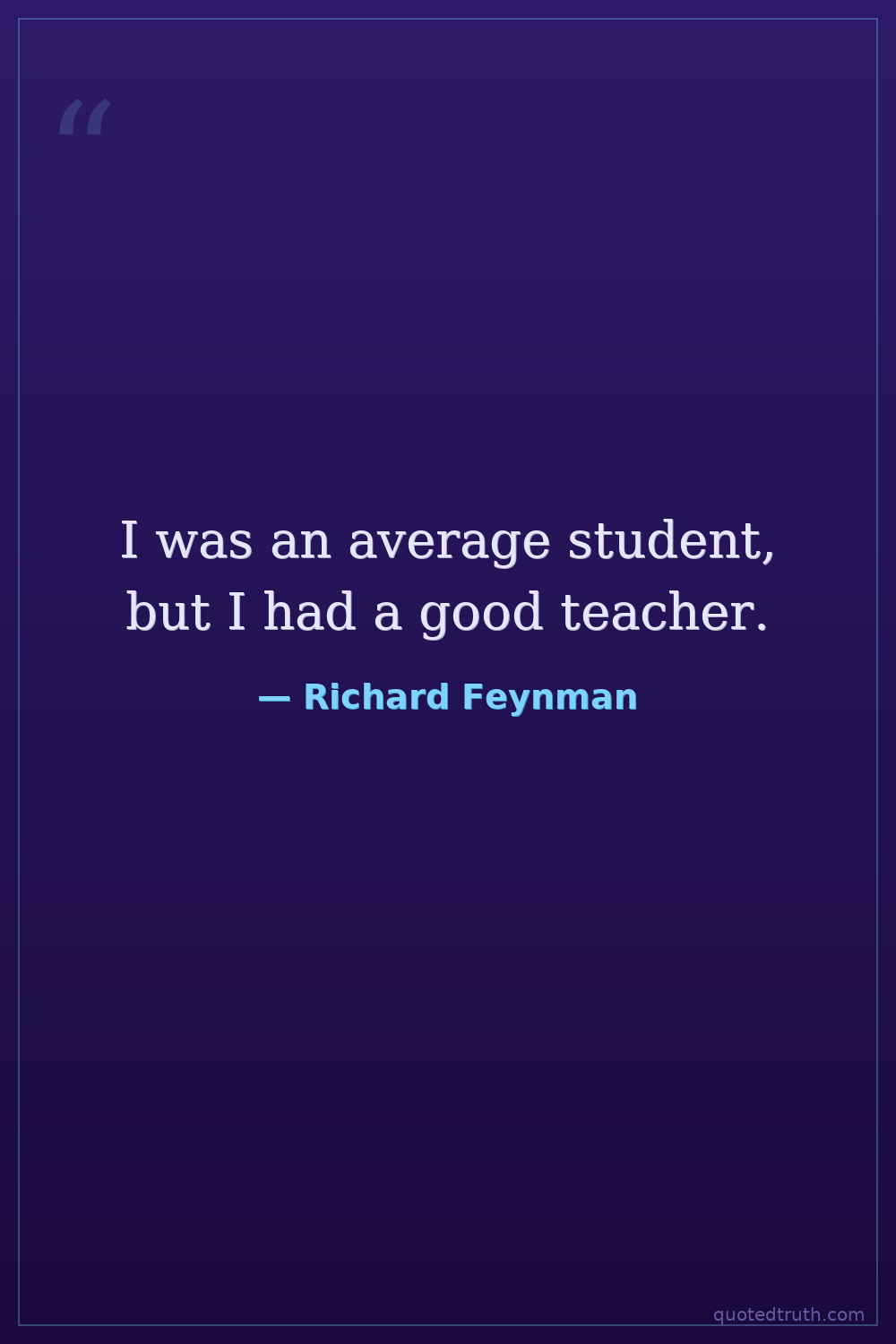
Richard Feynman — "I was an average student, but I had a good teacher."
I was an average student, but I had a good teacher.
I was an average student, but I had a good teacher.
Click any product to generate a realistic preview. Up to 3 at a time.
* Initial load can take up to 90 seconds — revising the preview in another color is nearly instant.
"I would often go to these conferences where they would talk about the ultimate theory, and I would always say, 'What's the ultimate experiment?'"
"I asked him once, 'How do you tell when a mathematical argument is correct?' He said, 'If it's beautiful, it's correct.'"
"I got a dollar for my patent! I give it to everybody. Result: everybody who has one of these patent because it was easy a lot of people had been sending things in lots of patents. Everybody come down …"
"I was in an intellectual fight with my father, and I kept saying, 'But the books say it!' And he said, 'The books are wrong!'"
"The game is to find out how nature works."
American theoretical physicist who shared the 1965 Nobel for QED, developed Feynman diagrams, and wrote the Feynman Lectures on Physics. Closely associated with Julian Schwinger (co-Nobelist for QED) and Murray Gell-Mann (Caltech rival and Eightfold-Way physicist). For an intellectual contrast, see Deepak Chopra, physician and quantum-mysticism author — Feynman's Caltech 'cargo cult science' commencement address is the precise template for what he saw as misuse of physics terminology — Chopra-style appropriation of quantum vocabulary for metaphysical claims is the canonical example of what Feynman called 'fooling yourself'.
Found in 1 providers: grok
1 source checked
Humility about one's own raw talent paired with honest credit to a mentor's guidance captures something true about how mastery develops. Natural ability matters less than the quality of instruction and the relationship that ignites lasting curiosity. Acknowledging that someone else helped shape your thinking isn't self-deprecation — it's an honest account of how knowledge actually passes from one mind to another.
Feynman was profoundly shaped by his father Melville, who taught him to observe nature and question received explanations rather than memorize answers. Despite winning the 1965 Nobel Prize in Physics for quantum electrodynamics, Feynman consistently deflected genius-myths, crediting curiosity over innate brilliance. He became a legendary teacher at Caltech himself, suggesting he understood mentorship as a chain — the lesson he received was one he felt obligated to pass forward.
Feynman worked through mid-20th-century America, when Cold War rivalry and Sputnik's 1957 launch triggered a national crisis over science education. Federal funding poured into STEM via the National Defense Education Act, and debate intensified about whether great scientists were born or cultivated. In that climate, a Nobel laureate crediting a teacher rather than personal genius was a culturally meaningful statement about how a nation actually builds scientific capability.
AI-generated insights based on extensive research and information for context. Factual errors? Email [email protected].
Your cart is empty