What it means
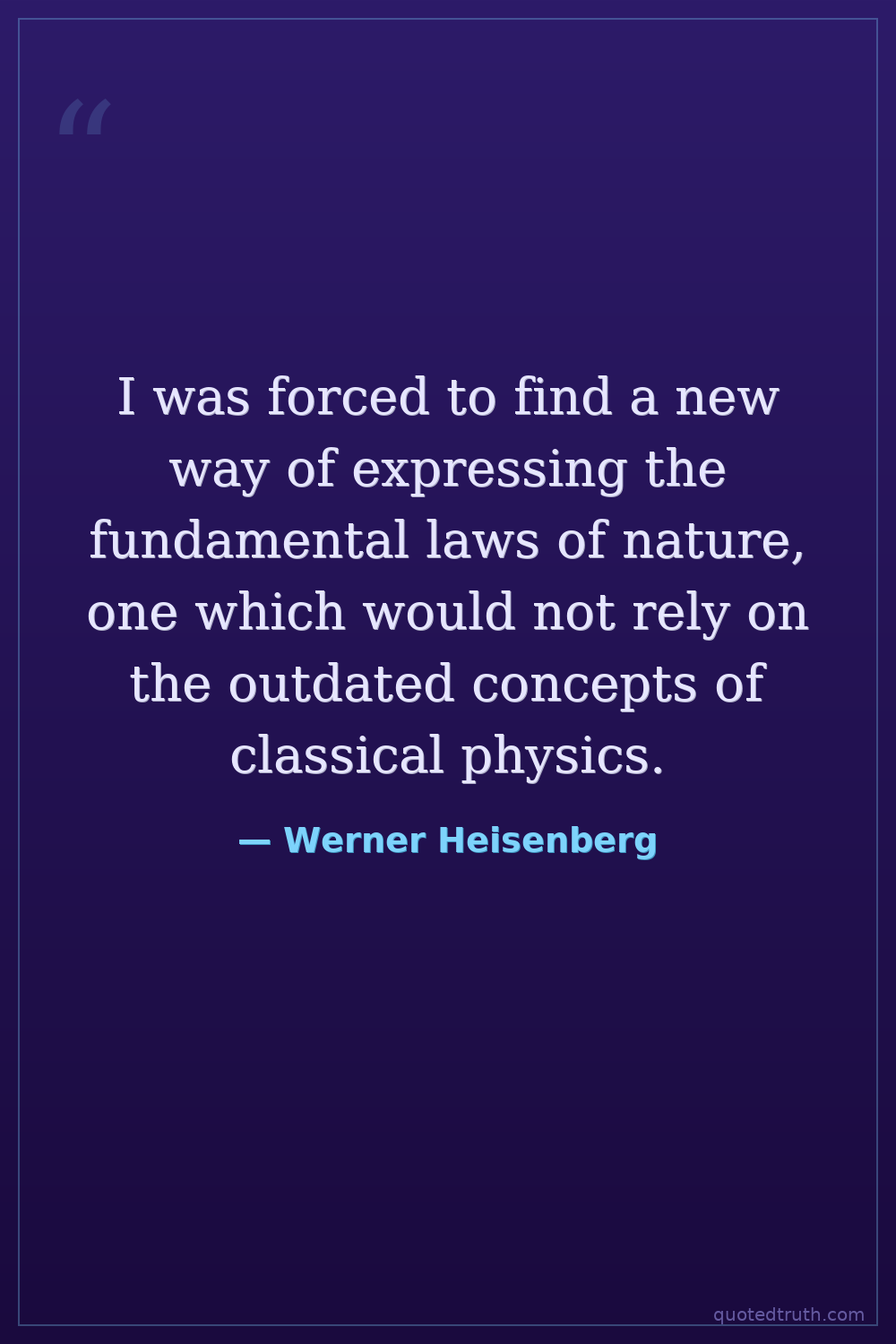
The speaker realized that older scientific ideas could no longer accurately describe reality at the smallest scales. Pushed by evidence that didn't fit existing theory, they had to invent entirely new mathematical language and frameworks to capture how nature actually behaves. Rather than patching old models, genuine progress required abandoning familiar assumptions and building a fresh system from scratch, even when that meant letting go of intuitive pictures of how the world works.
Relevance to Werner Heisenberg
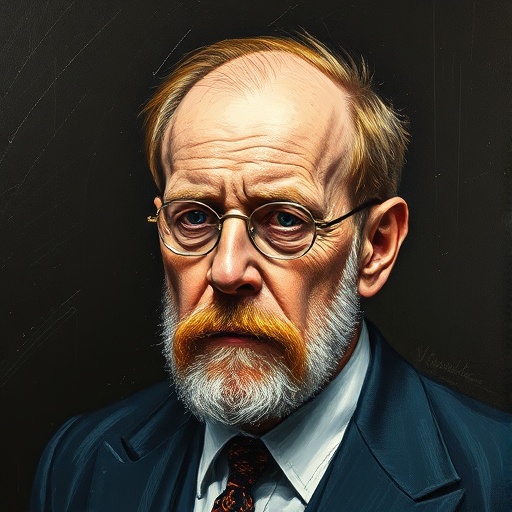
Heisenberg developed matrix mechanics in 1925 after concluding that classical notions like particle trajectories were meaningless for atoms. His 1927 uncertainty principle formalized the break, showing position and momentum cannot both be precisely known. A student of Bohr and Sommerfeld, he won the 1932 Nobel Prize. This statement mirrors his philosophical conviction that physics should describe only observable quantities, not borrowed classical imagery.
The era
The 1920s were a revolutionary decade for physics. Rutherford's nuclear atom, Bohr's quantized orbits, and puzzling spectral data had exposed classical mechanics' failure at atomic scales. Einstein's relativity had already reshaped space and time. Young physicists across Germany, Denmark, and Austria were racing to build quantum theory amid Weimar-era intellectual ferment. By decade's end, matrix and wave mechanics emerged simultaneously, overturning three centuries of Newtonian certainty and reshaping humanity's conception of reality.
AI-generated insights based on extensive research and information for context. Factual errors? Email [email protected].