Werner Heisenberg — "The decision to break with the tradition of classical physics was a very difficu…"
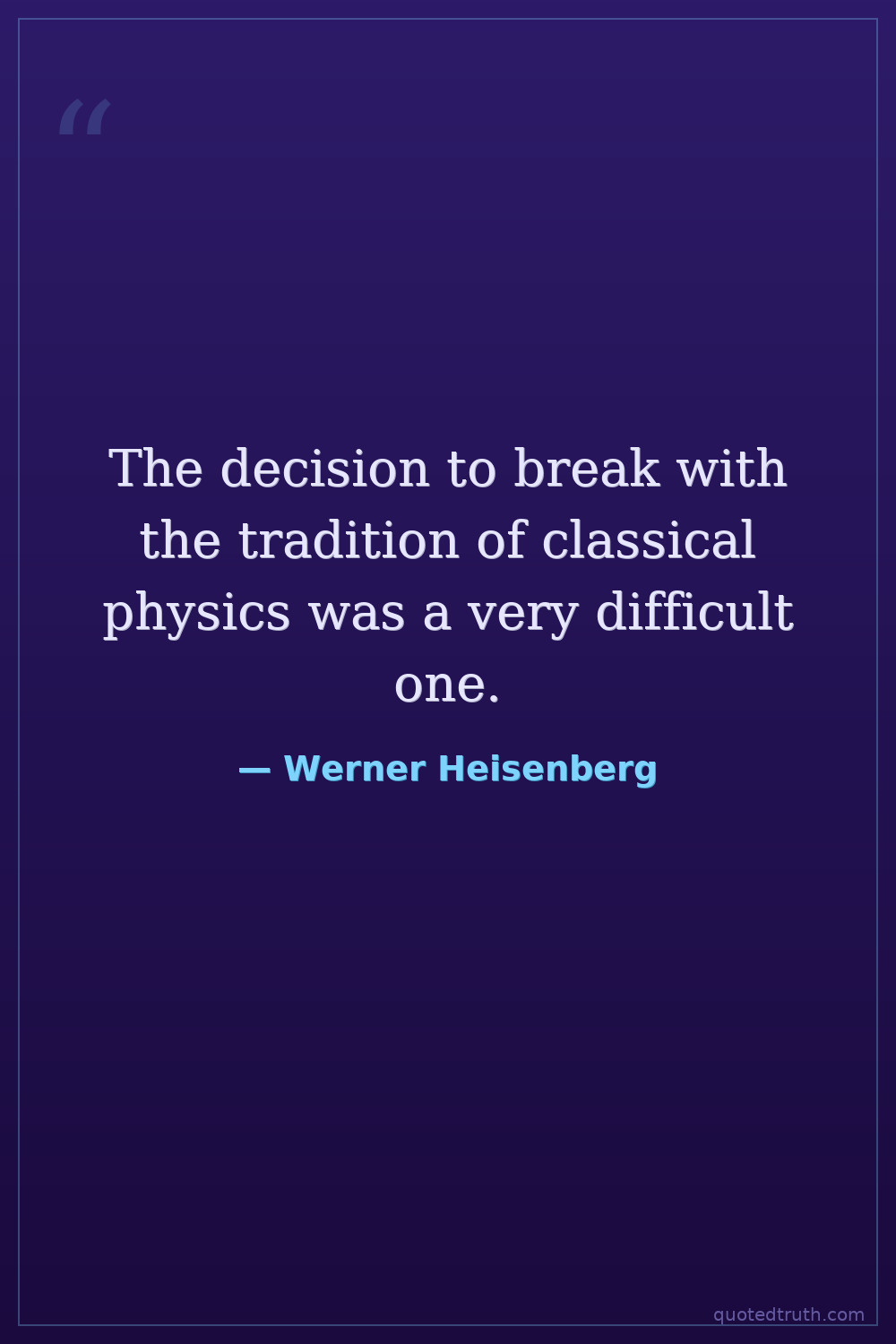
The decision to break with the tradition of classical physics was a very difficult one.
The decision to break with the tradition of classical physics was a very difficult one.
Click any product to generate a realistic preview. Up to 3 at a time.
* Initial load can take up to 90 seconds — revising the preview in another color is nearly instant.
"The existing scientific concepts cover always only a very limited part of reality, and the other part which has not yet been understood is infinite."
"Physics does not consist only of atomic research, science does not consist only of physics, and life does not consist only of science. The aim of atomic research is to fit our empirical knowledge conc…"
"The path to the new physics was paved by the discovery of the quantum of action."
"I was very much afraid of the consequences of the atom bomb, and I tried to delay its development."
"Modern physics has, in a certain sense, revived Plato's philosophy of forms in the atomic world."
Recalling the intellectual struggle of quantum theory's development
Date: 1958 (Physics and Beyond)
EducationalFound in 1 providers: grok
1 source checked
Abandoning long-held scientific ideas is painful, even when evidence demands it. Heisenberg is admitting that rejecting the deterministic, mechanical worldview of Newton and Maxwell wasn't a triumphant leap but a reluctant surrender. Trained minds resist overturning frameworks that have explained nature for centuries. Progress in physics required not just new math but the emotional willingness to let go of intuitive certainty about how reality behaves at every scale.
Heisenberg personally executed this break in 1925 when he formulated matrix mechanics on Heligoland, replacing visualizable orbits with abstract observables. His 1927 uncertainty principle dismantled the assumption that particles have simultaneous definite position and momentum. Coming from Sommerfeld's classical training in Munich, he understood exactly what was being discarded. The quote reflects his lifelong tension between respecting physics' heritage and following equations wherever they led, even into philosophical territory that unsettled Einstein.
The 1920s shattered classical certainty across disciplines. Einstein's relativity had already bent space and time; Bohr's Copenhagen circle was wrestling with atomic spectra that Newtonian mechanics couldn't explain. Blackbody radiation, the photoelectric effect, and electron diffraction demanded a probabilistic framework. Simultaneously, Weimar Germany was intellectually fertile but politically unstable. Heisenberg worked amid this upheaval alongside Bohr, Born, and Pauli, building quantum theory while Europe itself was breaking with its pre-war traditions in art, politics, and philosophy.
AI-generated insights based on extensive research and information for context. Factual errors? Email [email protected].
Your cart is empty