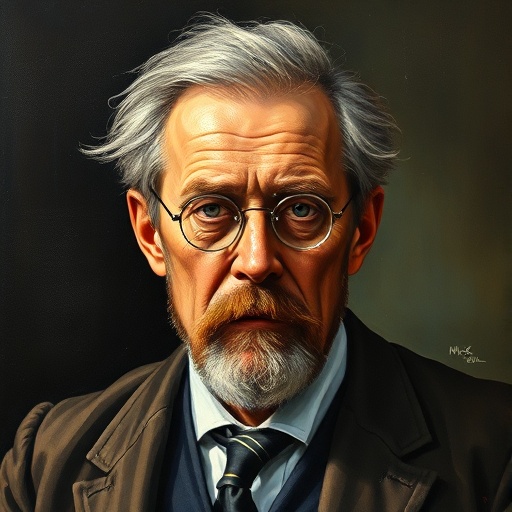
Max Planck — "I was never a revolutionary. I just wanted to do something useful."
I was never a revolutionary. I just wanted to do something useful.
I was never a revolutionary. I just wanted to do something useful.
Click any product to generate a realistic preview. Up to 3 at a time.
* Initial load can take up to 90 seconds — revising the preview in another color is nearly instant.
"The pioneer in a new field of knowledge is never a popular man."
"My original decision to devote myself to science was a direct result of the discovery, which has never ceased to fill me with enthusiasm, that the laws of nature are accessible to human thought."
"The scientist's task is to find the laws of nature, not to invent them."
"The future of humanity depends on our ability to understand and harness the power of science."
"The human spirit is capable of reaching for the stars."
Found in 1 providers: grok
1 source checked
The speaker rejects the label of rebel or radical, insisting their motivation was practical usefulness, not disruption. They saw themselves as a careful contributor trying to solve real problems, not someone chasing fame, controversy, or sweeping change. Even when their work upended established thinking, they framed it modestly: the goal was to fix what wasn't working, help the field move forward, and produce something genuinely valuable rather than to overthrow existing ideas.
Planck was deeply conservative by temperament, a Prussian academic who revered classical physics and reluctantly introduced the quantum hypothesis in 1900 to solve blackbody radiation. He called it an act of desperation, not rebellion. For years he tried to reconcile quanta with classical theory before accepting its revolutionary implications. He served as a loyal institutional figure, leading the Kaiser Wilhelm Society, embodying duty over disruption throughout his long career.
Planck worked through early 20th-century Germany, an era when physics felt nearly complete and classical mechanics reigned supreme. His 1900 quantum discovery reluctantly cracked that foundation, launching modern physics alongside Einstein's relativity. He lived through two world wars, the collapse of Imperial Germany, Weimar instability, and Nazi rule, which cost him his son Erwin, executed in 1945. Amid political upheaval and scientific revolution, Planck valued continuity, service, and honest work over ideological or intellectual radicalism.
AI-generated insights based on extensive research and information for context. Factual errors? Email [email protected].
Your cart is empty