What it means
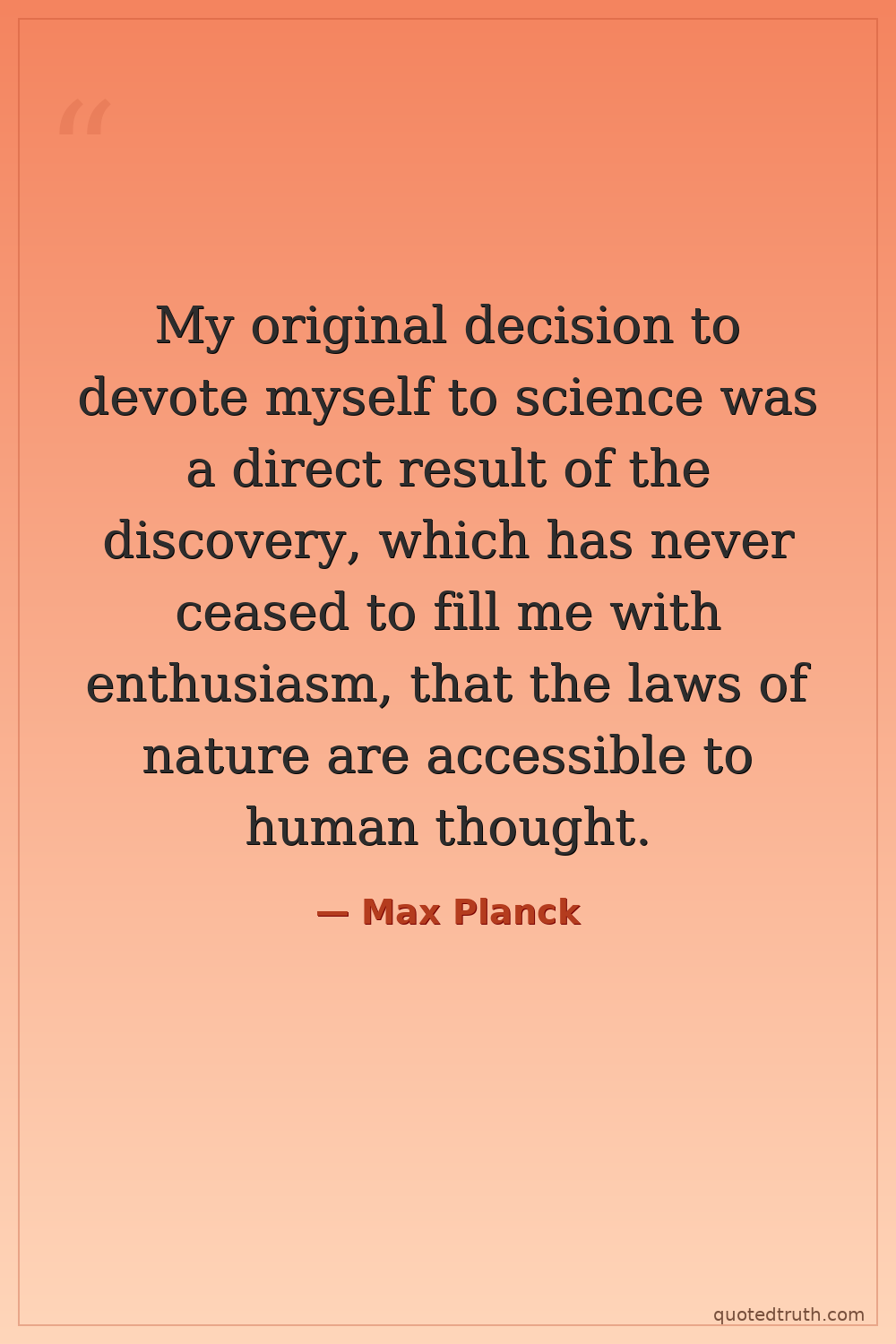
Planck is saying he chose science because he found it thrilling that nature follows rules the human mind can actually grasp. The universe is not chaotic or locked away from us; its deep patterns can be uncovered through reasoning and measurement. That realization, that thought can reach reality, gave him a lifelong sense of wonder and purpose, and it was the single spark that pulled him toward a research career.
Relevance to Max Planck
Planck spent decades deriving the blackbody radiation law, which forced him to introduce the quantum of action in 1900 and launched quantum theory. A devout Lutheran who believed a rational order underlay nature, he saw physics as decoding that order. His persistence through personal tragedy, losing sons in both world wars, reflects the same conviction expressed here: that disciplined human thought can reach the lawful structure of reality, and that pursuit is worth a life.
The era
Planck worked from the 1880s through the 1940s, as classical physics cracked open. Maxwell's equations, thermodynamics, and then relativity and quantum mechanics were rewriting what matter and energy were. German universities led world science, and Berlin was its capital. Against that backdrop of rapid, almost intoxicating discovery, and later the moral collapse of Nazi Germany, Planck's statement captures the Enlightenment faith, still alive in his generation, that the cosmos is intelligible and worth a human life to study.
AI-generated insights based on extensive research and information for context. Factual errors? Email [email protected].