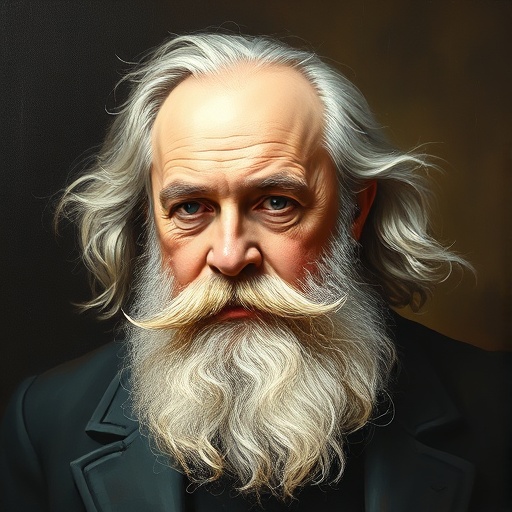
Dmitri Mendeleev — "I was very much interested in spiritualism, but I found no scientific basis for …"
I was very much interested in spiritualism, but I found no scientific basis for it.
I was very much interested in spiritualism, but I found no scientific basis for it.
Click any product to generate a realistic preview. Up to 3 at a time.
* Initial load can take up to 90 seconds — revising the preview in another color is nearly instant.
"The greatest good is the knowledge of the truth."
"The invisible world of chemical atoms is still waiting for the creator of chemical mechanics."
"To protect the Russian borders from enemies, I would surround the whole country with a continuous wall of vodka."
"The progress of science is a series of corrections."
"One day, all elements will be discovered and their properties understood."
Found in 1 providers: grok
1 source checked
The speaker admits a genuine fascination with spiritualism—séances, mediums, and claims of contact with the dead—but says investigation revealed no evidence that would hold up to rigorous testing. Curiosity led to inquiry; inquiry produced nothing measurable, repeatable, or explainable by natural laws. Rather than believe on feeling alone, the speaker withheld endorsement. It is a statement about following evidence wherever it leads, even when the conclusion disappoints a personal hope or interest.
Mendeleev personally investigated spiritualism in the 1870s as part of a Russian Physical Society commission examining mediums in St. Petersburg, and publicly concluded the phenomena were fraudulent or unproven. The same empirical discipline that let him predict gallium, scandium, and germanium from gaps in his periodic table demanded testable evidence here too. His refusal to accept séance claims without measurement mirrors the systematic, law-seeking mind that organized the elements by atomic weight and properties.
In late-nineteenth-century Russia and Europe, spiritualism was a mass phenomenon: table-rapping, séances, and mediums like the Fox sisters drew educated believers including scientists such as William Crookes and Alfred Russel Wallace. This collided with an expanding materialist science—thermodynamics, evolution, spectroscopy, Mendeleev's own chemistry. Universities and scientific societies formed commissions to test paranormal claims. Mendeleev's verdict landed in that cultural battle between occult revival and the professionalizing, evidence-based science reshaping Russian intellectual life.
AI-generated insights based on extensive research and information for context. Factual errors? Email [email protected].
Your cart is empty