What it means
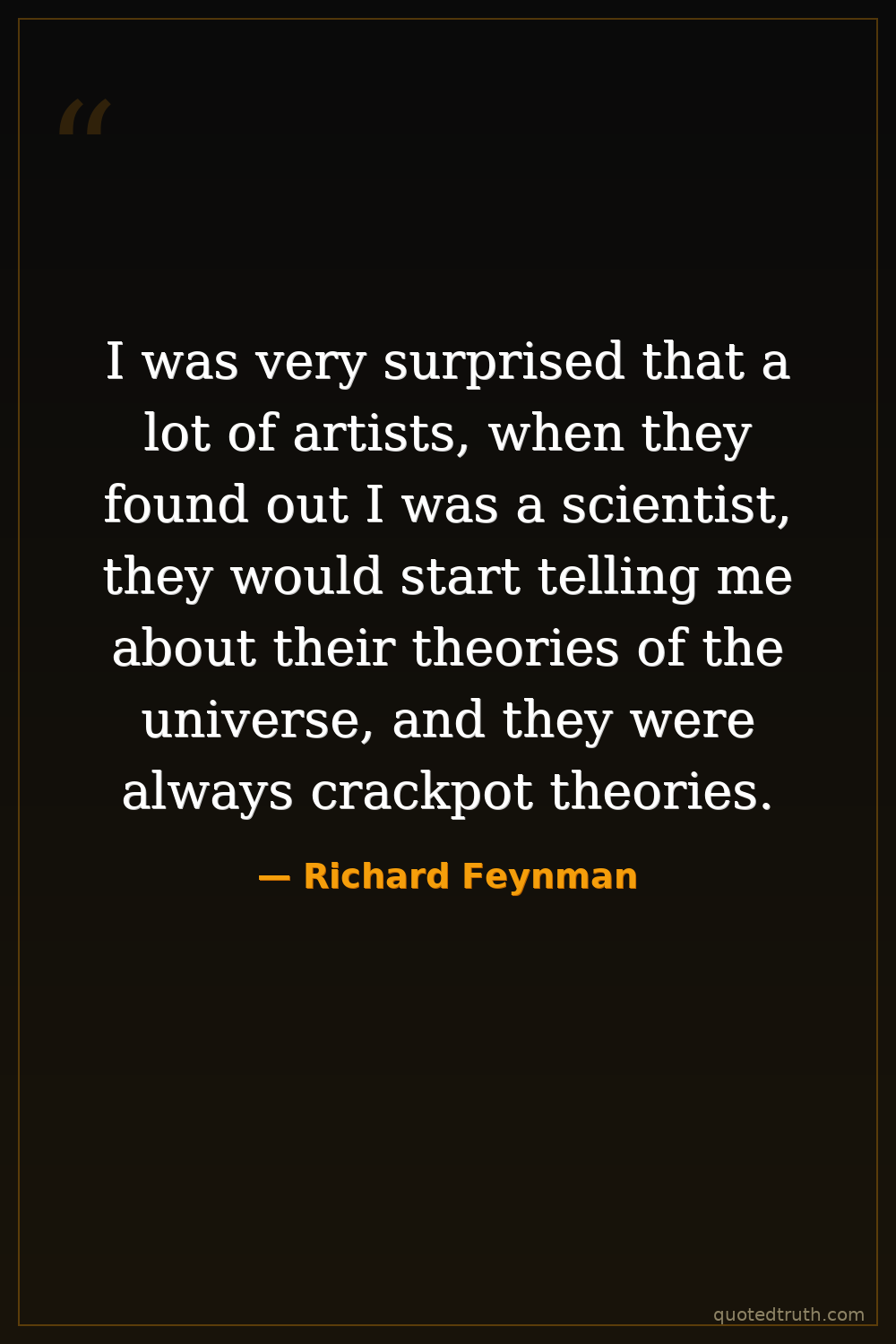
When artists discovered Feynman was a scientist, they eagerly shared their personal theories about how the universe works — but these theories were consistently unscientific and unfounded. Feynman found it striking that creative people felt compelled to philosophize about physics without rigorous grounding, revealing a gap between artistic intuition and scientific methodology that surprised him given how confidently these ideas were presented.
Relevance to Richard Feynman
Feynman was legendarily committed to intellectual honesty and despised pseudoscience and cargo-cult thinking. As a Nobel Prize-winning physicist who worked on the Manhattan Project and quantum electrodynamics, he had little patience for unfounded speculation dressed as insight. Yet he genuinely loved art — he painted, played bongo drums, frequented strip clubs to sketch — making his frustration with artistic crackpot theorizing particularly pointed and personally felt.
The era
The mid-20th century saw a romantic cultural collision between art and science — the Beat Generation, abstract expressionism, and counterculture movements often romanticized alternative cosmologies, Eastern mysticism, and intuitive 'knowing' over empirical rigor. Many artists viewed scientists as kindred creative spirits, not realizing the fundamental discipline separating creative speculation from testable hypothesis. This era's anti-establishment sentiment frequently positioned fringe theories as brave alternatives to scientific orthodoxy.
AI-generated insights based on extensive research and information for context. Factual errors? Email [email protected].