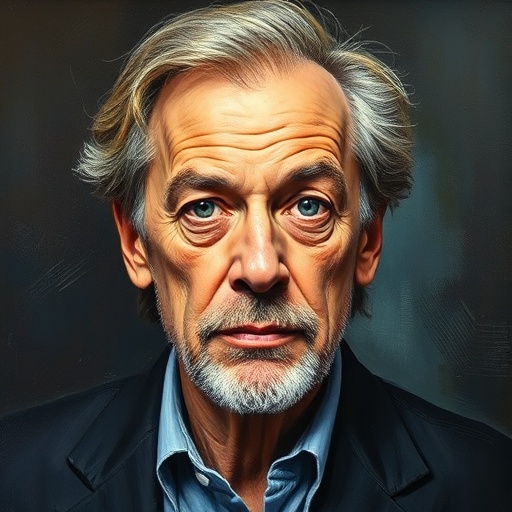
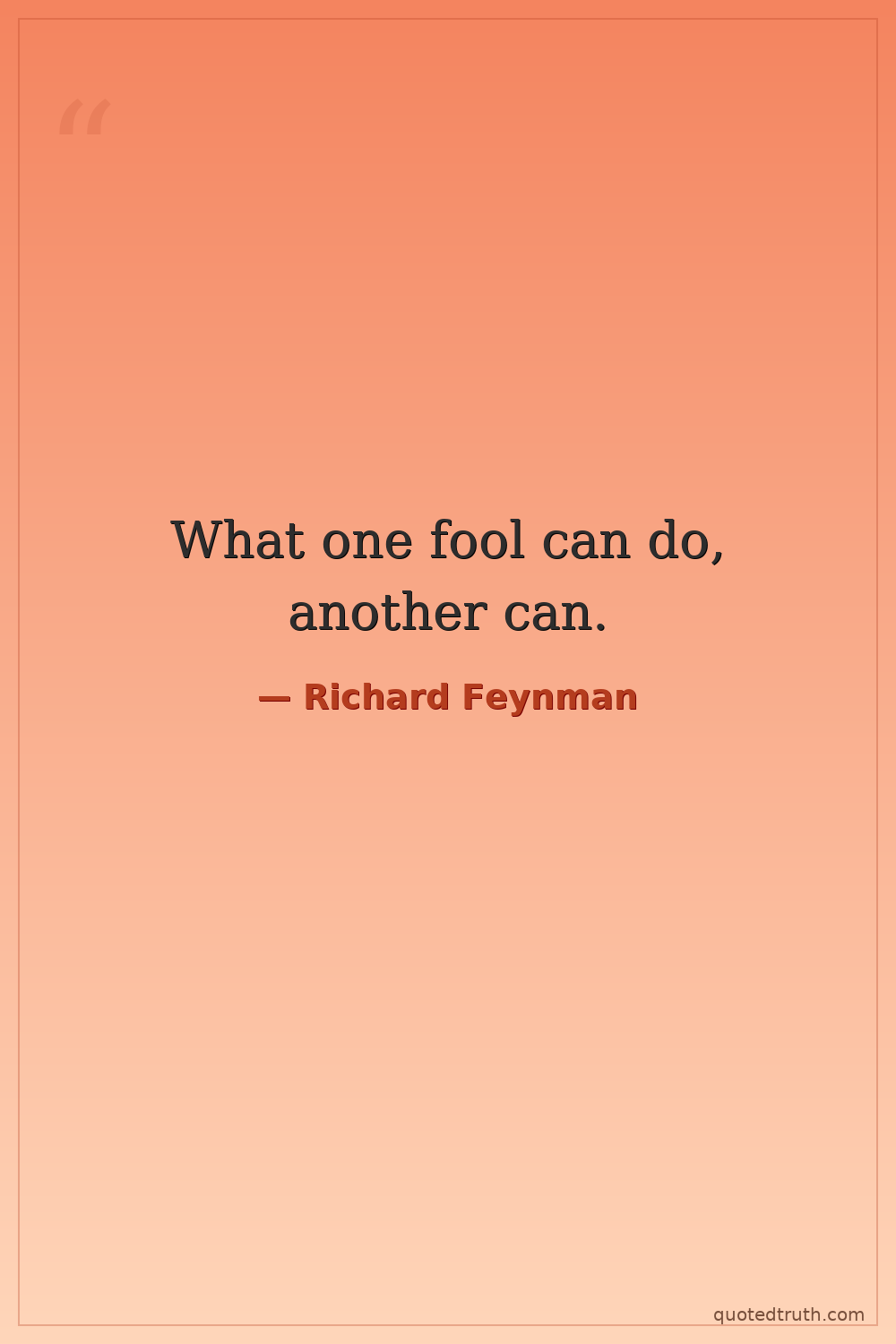
Richard Feynman — "What one fool can do, another can."
What one fool can do, another can.
What one fool can do, another can.
Click any product to generate a realistic preview. Up to 3 at a time.
* Initial load can take up to 90 seconds — revising the preview in another color is nearly instant.
"I don't understand anything in biology. I don't understand anything in chemistry. I don't understand anything in mathematics. I don't understand anything in physics. I don't understand anything in any…"
"I took the wavicles—the little particles of waves—and put them in a box."
"I have often thought that if there is any hell, it must be the place where there are no questions, only answers."
"If you're going to be a scientist, you don't need to be a genius. You just need to be able to work hard and be curious."
"The more you learn, the more you realize how much you don't know."
American theoretical physicist who shared the 1965 Nobel for QED, developed Feynman diagrams, and wrote the Feynman Lectures on Physics. Closely associated with Julian Schwinger (co-Nobelist for QED) and Murray Gell-Mann (Caltech rival and Eightfold-Way physicist). For an intellectual contrast, see Deepak Chopra, physician and quantum-mysticism author — Feynman's Caltech 'cargo cult science' commencement address is the precise template for what he saw as misuse of physics terminology — Chopra-style appropriation of quantum vocabulary for metaphysical claims is the canonical example of what Feynman called 'fooling yourself'.
Found in 1 providers: grok
1 source checked
The sentiment is radically democratic: any task or skill mastered by one ordinary person is learnable by any other. It rejects the idea that expertise belongs only to innate geniuses, arguing that persistence and effort bridge the gap. If a so-called fool cracked the problem, your own intelligence isn't the limiting factor — your willingness to work through it is.
Feynman built his identity around making physics accessible — his legendary Caltech undergraduate lectures, bongo-drum irreverence, and safecracking at Los Alamos all signaled that genius wasn't mystical. He pioneered the Feynman Technique: learn anything by re-teaching it simply. Growing up fixing radios in Far Rockaway, he trusted hands-on effort over raw intellect. This quote could have been his personal motto.
Feynman's career spanned the Manhattan Project through the Cold War space race — an era when scientists were mythologized as untouchable intellects who split atoms and reached the moon. Postwar America revered rocket scientists as a separate species, and university science grew increasingly gatekept. Feynman pushed back against that mystification, insisting curiosity and method drove discovery, making him one of the era's defining science communicators.
AI-generated insights based on extensive research and information for context. Factual errors? Email [email protected].
Your cart is empty