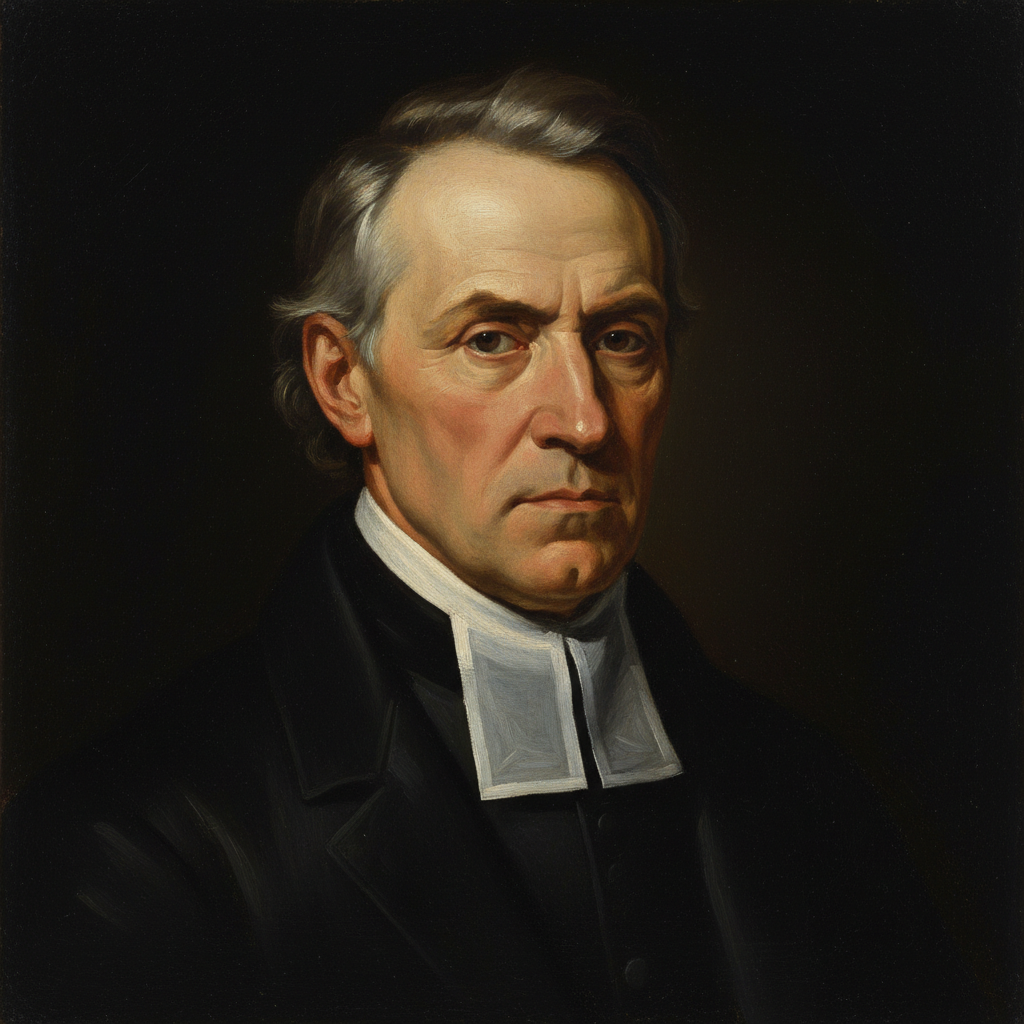
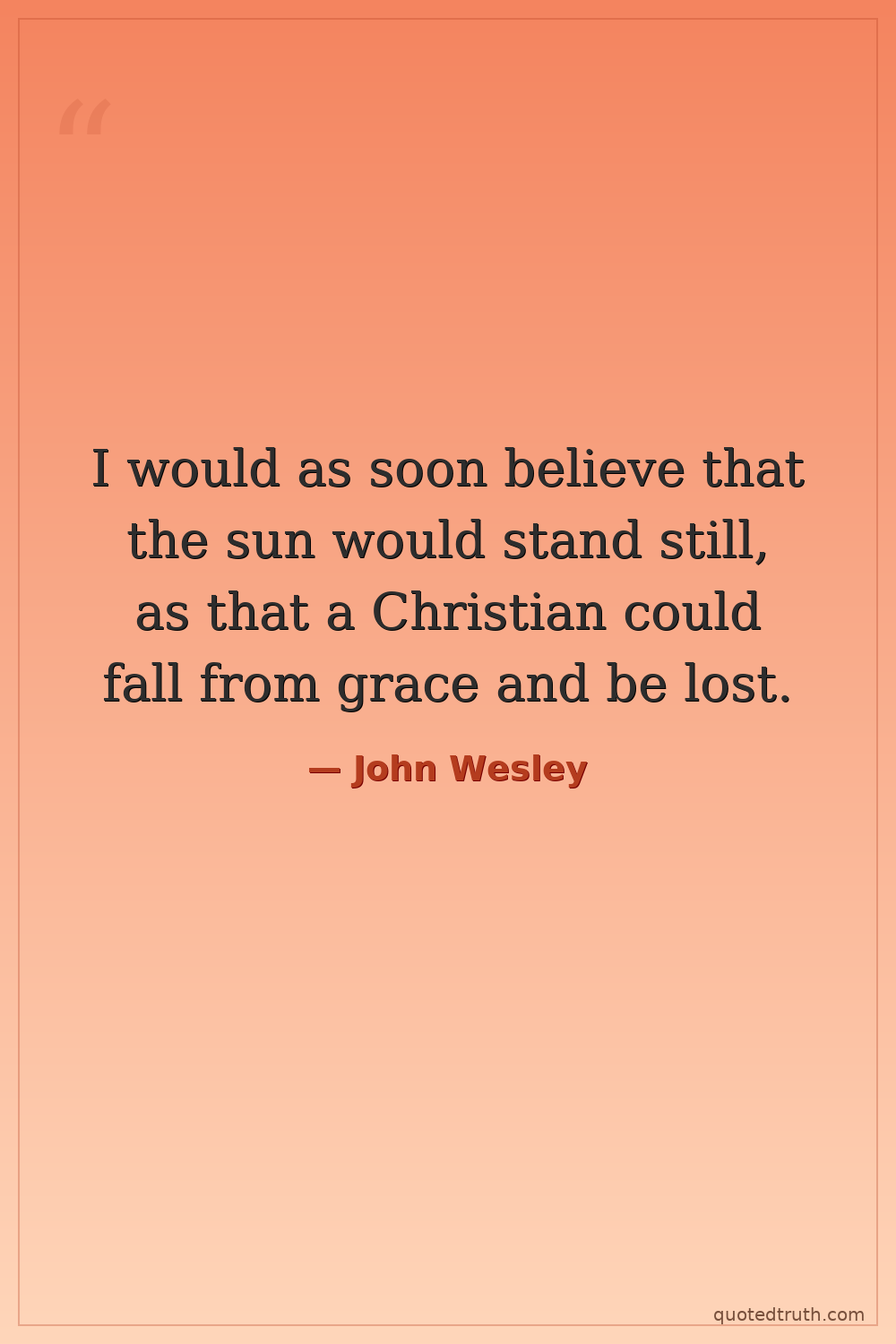
John Wesley — "I would as soon believe that the sun would stand still, as that a Christian coul…"
I would as soon believe that the sun would stand still, as that a Christian could fall from grace and be lost.
I would as soon believe that the sun would stand still, as that a Christian could fall from grace and be lost.
Click any product to generate a realistic preview. Up to 3 at a time.
* Initial load can take up to 90 seconds — revising the preview in another color is nearly instant.
"I wish to have no other evidence of the truth of Christianity than the power of God upon my own heart."
"Preach not doctrines, but Christ."
"I have often thought that the reason why so few are saved, is, because so few are willing to be saved."
"I am as much a High-Churchman as ever I was. And I hope to live and die so."
"I offered Christ to the Negroes in Antigua. I offered him to the slaves. I offered him to the very dregs of the people."
English Anglican cleric and founder of Methodism, whose open-air preaching and class-meeting structure created the largest 18th-century evangelical revival. Closely associated with Charles Wesley (his hymn-writing brother) and George Whitefield (early co-revivalist, later doctrinal opponent). For an intellectual contrast, see George Whitefield, Calvinist evangelical revivalist — Whitefield's predestinarian Calvinism vs Wesley's free-grace Arminian theology split the early Methodist movement permanently in the 1739-41 break. The founding evangelical Calvinist-Arminian schism — the two parallel evangelical traditions American Christianity descends from.
Found in 1 providers: grok
1 source checked
This quote asserts absolute confidence that genuine Christians cannot lose their salvation — a doctrine called eternal security or perseverance of the saints. By invoking the sun standing still as a reference to miraculous impossibility, it treats apostasy as equally unthinkable. The comparison frames a saved soul's perseverance as cosmically certain, making damnation after true conversion as inconceivable as overturning the laws of nature.
Ironically, Wesley was a committed Arminian who explicitly taught that Christians could fall from grace and forfeit salvation — directly opposing Calvinist eternal security. His founding of Methodism was partly built on that conviction, emphasizing ongoing faith, holiness, and moral vigilance. This quote likely reflects a rhetorical inversion, a misattribution, or Wesley quoting opponents, because it contradicts his core published theology on apostasy and free will.
Wesley lived in 18th-century Britain during fierce Calvinist-Arminian theological battles. George Whitefield championed Calvinist perseverance of the saints, while Wesley's Methodism stressed free will and the real danger of backsliding. This doctrinal fault line fractured the evangelical revival movement of the 1740s, splitting Wesley and Whitefield's partnership and defining competing Protestant identities across Britain and colonial America for generations.
AI-generated insights based on extensive research and information for context. Factual errors? Email [email protected].
Your cart is empty