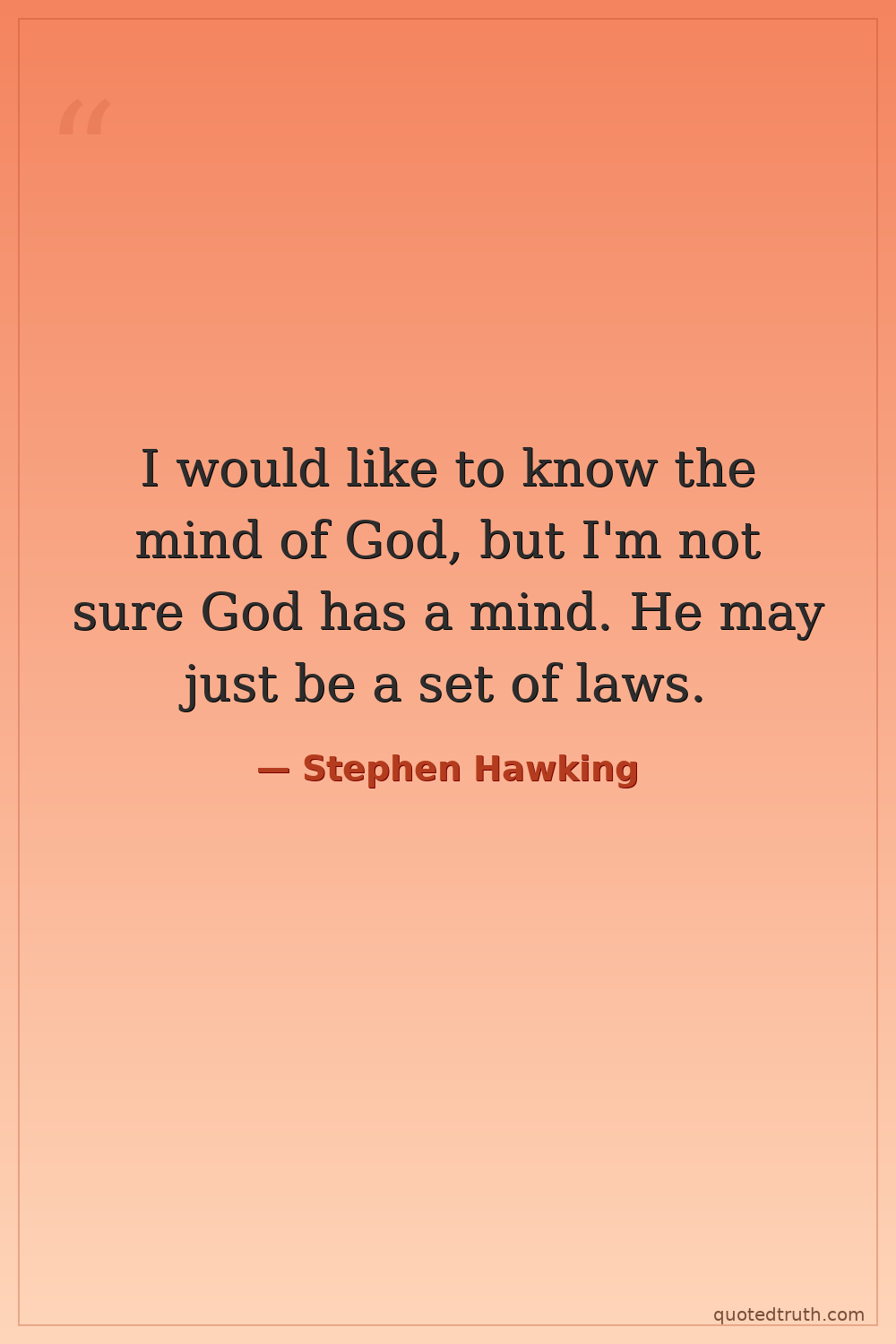
Stephen Hawking — "I would like to know the mind of God, but I'm not sure God has a mind. He may ju…"
I would like to know the mind of God, but I'm not sure God has a mind. He may just be a set of laws.
I would like to know the mind of God, but I'm not sure God has a mind. He may just be a set of laws.
Click any product to generate a realistic preview. Up to 3 at a time.
* Initial load can take up to 90 seconds — revising the preview in another color is nearly instant.
"We are in danger of destroying ourselves by our greed and stupidity. We cannot remain looking inwards at ourselves on a small and increasingly polluted and overcrowded planet."
"The universe is a grand design, and we are but tiny parts of it."
"I am an optimist, but I am a realist who understands that science is a slow process."
"I have always been fascinated by the big questions."
"I think that the human race has a destiny to explore the universe."
British theoretical physicist whose Hawking radiation work and A Brief History of Time (1988) brought black-hole physics to a mass audience while he lived with ALS for 55 years. Closely associated with Roger Penrose (his collaborator on singularity theorems) and Carl Sagan (fellow popularizer who wrote Brief History's foreword). For an intellectual contrast, see William Lane Craig, American philosopher of religion — Craig's Kalam cosmological argument depends on the Big Bang requiring a divine first cause; Hawking's no-boundary proposal was specifically designed to remove the moment that would require one — the cleanest cosmology-vs-natural-theology contrast in modern thought.
Found in 1 providers: grok
1 source checked
The deepest goal of physics is understanding the rules that govern everything. Hawking uses 'God' as a metaphor for that ultimate framework — but then questions whether any conscious mind exists behind it. He suggests the universe might be entirely explained by impersonal mathematical laws, requiring no divine intelligence. Knowledge of those laws would be humanity's closest approach to 'knowing God' — not through prayer, but through an equation.
Hawking closed 'A Brief History of Time' (1988) with a desire to 'know the mind of God,' making this a lifelong theme. As the physicist who developed singularity theorems and Hawking radiation, he probed whether the universe required a beginning — and a creator. Openly agnostic, he argued his no-boundary proposal meant creation needed no divine spark, just physics operating on itself without external cause.
Hawking worked through an era of profound cosmological discovery — the Big Bang model confirmed by satellite measurements of the cosmic microwave background, dark energy rewriting cosmic expansion, and the Higgs boson theorized. Simultaneously, New Atheism (Dawkins, Hitchens, Dennett) and intelligent design controversies made physics claiming to explain origins without God culturally charged. Hawking's voice carried unusual weight in that debate as both scientist and public icon.
AI-generated insights based on extensive research and information for context. Factual errors? Email [email protected].
Your cart is empty